Heads up: this post contains affiliate links. If you buy through one, we may earn a small commission at no extra cost to you. As an Amazon Associate, we earn from qualifying purchases.
⚡ Quick Answer: The most RV-friendly national parks are Zion, Yellowstone, Grand Teton, Great Smoky Mountains, Acadia, Joshua Tree, Badlands, and Olympic. Book on Recreation.gov up to six months ahead, check your rig against each campground’s length limit (many cap at 27–40 feet), and have a TPMS and backup camera for the mountain roads and tight loops.
National parks and RVs were made for each other: you wake up inside the postcard, coffee in hand, before the day-trip crowds arrive. But not every park campground fits every rig — length limits, tight loops, and scarce hookups catch plenty of RVers off guard.
These eight parks earn their spots by combining signature scenery with campgrounds that genuinely work for RVs. For each one we note the campground to target and the fine print worth knowing before you book.
1. Zion National Park, Utah
Watchman Campground sits walking distance from the visitor center with electric hookups and views of the canyon walls turning gold at sunset. Sites fit rigs to about 40 feet in some loops. Book six months out to the day; summer sells out in minutes. Note the Zion–Mount Carmel Tunnel requires an escort fee and size rules for larger rigs.
2. Yellowstone National Park, Wyoming
Fishing Bridge RV Park is the only campground in Yellowstone with full hookups, and it takes hard-sided rigs only (bear country rules). Grant Village and Madison handle big rigs without hookups. Cell service is thin and distances are huge — arrive with tanks ready and a full fridge.
3. Grand Teton National Park, Wyoming
Colter Bay RV Park offers full hookups with the Teton skyline over Jackson Lake, and Gros Ventre’s cottonwood loops handle large rigs beautifully. Mornings here mean moose in the willows and alpenglow on the range from your dinette.
4. Great Smoky Mountains National Park, Tennessee / North Carolina
Cades Cove Campground puts you inside the park’s famous wildlife loop — expect deer at your door and black bears in the orchards. No hookups and a 35-foot limit in most sites, but generators are allowed in designated hours. Elkmont, near Gatlinburg, is the bigger-rig alternative.
5. Acadia National Park, Maine
Blackwoods and Seawall campgrounds tuck RVs under spruce minutes from Park Loop Road; Schoodic Woods across the bay adds electric hookups and fewer crowds. Most sites cap in the mid-30s. Sunrise from Cadillac Mountain, lobster rolls by dinner — coastal RV camping does not get better.
6. Joshua Tree National Park, California
Jumbo Rocks is the classic: sites wedged between giant granite formations, no hookups, dark-sky stargazing that borders on unreal. Most sites fit rigs to about 25–35 feet; Cottonwood handles some larger. Bring water — the park has almost none — and a generator or solar for shoulder-season heat.
7. Badlands National Park, South Dakota
Cedar Pass Campground has electric hookups and front-row seats to banded pink buttes that glow at dusk; prairie dogs and bighorn sheep are practically neighbors. Pair it with a Black Hills loop and you have one of America’s great RV weeks.
8. Olympic National Park, Washington
Kalaloch Campground perches on a bluff over the Pacific — fall asleep to surf from your bed. Sol Duc adds hookups near hot springs and rainforest. Many loops are tight and shaded; know your length and bring your patience for the coastal fog that burns off into glory by noon.
Booking and Driving Tips for Park Campgrounds
- Reservations open on Recreation.gov, most six months ahead, rolling daily — set an alarm for the moment your window opens.
- Know your true length including hitch and bikes; rangers do measure, and a 36-foot rig does not fit a 30-foot pad.
- Mountain grades and tight campground loops are where a tire pressure monitoring system and a wireless backup camera pay for themselves.
- Hookups are scarce — arrive with a full fresh tank (fill stations are usually at the entrance) and empty waste tanks.
- Generator hours are enforced; solar keeps the peace.
Recommended Gear

- Large 3.15″ Color LCD featuring simultaneous PSI or Temperature Readings
- Checks for the following tire issues every 6 seconds: slow leaks, rapid leaks, blowouts, low pressure, high pressure and…
- Monitors up to 40 tires, from 0-199 psi, with +/- 1 PSI accuracy

- Dual Lens Road And Bumper View: AUTO-VOX brings a first of its kind dual lens view to this RV backup camera, using two l…
- Dual Antenna Stable View: This rv backup camera wireless system uses dual antennas on both the camera and monitor to hel…
- Prewired Power, 30 Min Quick Setup: On many factory prewired RVs, this wireless backup camera for rv connects to the exi…
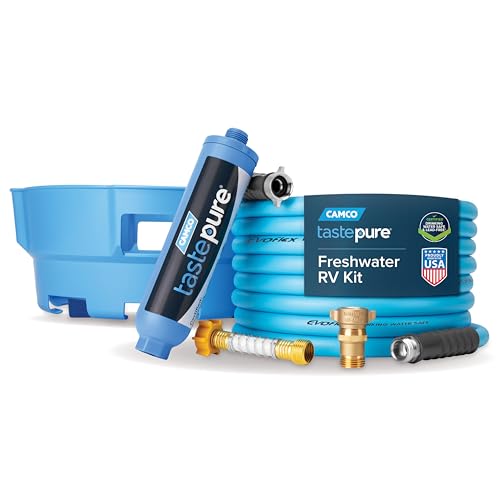
- Freshwater Accessories Kit: This RV bundle has all you need for fresh water on the go—a Tastepure Water Filter w/Flexibl…
- Simplified RV Camping Setup: Perfect for both first-timers and seasoned RVers, this RV kit takes the hassle out of gathe…
- 25ft Drinking Water Hose: The ultra-flexible EvoFLEX Hose offers superior flexibility & kink resistance. It’s CSA lead-f…
Frequently Asked Questions
What size RV fits in most national park campgrounds?
A rig of 27 feet or less fits the vast majority of national park campsites, while 35 feet is a common upper cutoff and only select campgrounds handle 40-plus. Always check the specific campground’s limit on Recreation.gov before booking, and measure your total length including the tow vehicle if you stay connected.
Do national park campgrounds have full hookups?
Most do not. Full hookups are the exception (Fishing Bridge in Yellowstone, Colter Bay in Grand Teton, and a handful of others), while many parks offer electric-only or no hookups at all. Plan to arrive with full fresh water and empty holding tanks, and know where the dump station is.
When should I book a national park RV site?
Book the moment your window opens — typically six months in advance on Recreation.gov for summer dates. Cancellations do pop up, so check back two weeks and again three days before your trip if you missed the first wave.
Prefer waking up to waves? See the best beach RV camping spots in the US.
Written by Jake Miller · Camping & Gear
Jake grew up pitching tents before he could drive and has spent 15+ years camping, car-camping, and gear-testing his way across the country. If it can be cooked over a fire or packed into a trunk, he has an opinion on it.