
Heads up: this post contains affiliate links. If you buy through one, we may earn a small commission at no extra cost to you. As an Amazon Associate, we earn from qualifying purchases.
⚡ Quick Answer: Add up the watt-hours each device needs per day, multiply by the number of days between recharges, then add 25 percent for inefficiency and cold weather. Most car campers land between 300 and 600 watt-hours. You only need a thousand or more if you are running a compressor fridge, a CPAP every night, or power tools.
Portable power stations are sold on a single number, the capacity in watt-hours, and that number is almost always bigger than you need. The pitch works because nobody knows how much power they use. So this guide does the arithmetic with you, using a method that takes about five minutes and reliably saves people a few hundred dollars.
Step one: list what you actually charge
Write down every device you will plug in during a trip, and how many times. Be honest, not aspirational. Most people discover the list is shorter than they assumed.
- Phone: roughly 15 to 20 watt-hours per full charge.
- Headlamp or lantern with a built-in battery: 5 to 15 watt-hours.
- Tablet: 30 to 40 watt-hours.
- Laptop: 50 to 100 watt-hours per charge, the single biggest item most people carry.
- Camera batteries: 10 to 20 watt-hours each.
- Satellite messenger or GPS: 5 to 15 watt-hours.
- 12 volt compressor fridge: 200 to 600 watt-hours per day depending on ambient temperature and how often you open it.
- CPAP without humidifier: roughly 30 to 60 watt-hours per night. With the heated humidifier, double or triple that.
Notice how the last two items dwarf everything else. If neither is on your list, you almost certainly do not need a large station.
Step two: multiply by days, then add margin
Take your daily total, multiply by the number of days before you can recharge, then add 25 percent. That margin covers inverter conversion losses, which are real and typically run 10 to 15 percent, plus cold-weather capacity loss and the general tendency to use more than you planned.
A worked example. Two phones charged daily is 40 watt-hours, a lantern is 10, and one laptop charge over the weekend is 70. Over three days that is roughly 220 watt-hours. Add 25 percent and you get 275. A 300 watt-hour station covers that trip comfortably, and it costs a fraction of a thousand watt-hour unit.
Step three: check the inverter, not just the capacity
Capacity tells you how long. The inverter rating tells you what you can run at all. An electric kettle drawing 1200 watts will trip a station rated for 300 watts continuous no matter how large its battery is. Look up the wattage on anything with a heating element, a motor, or a compressor, and compare it to the continuous rating first and the surge rating second.
The devices that catch people out are kettles, coffee makers, hair dryers, space heaters, and air compressors. Everything else in a normal camp kit is well under 100 watts.
How you plan to recharge changes the answer
A smaller station you can refill every day beats a larger one you cannot. If you have solar, the panel wattage becomes the real constraint, and there is a whole calculation there covered in how many solar watts you need for camping. If you are recharging from a vehicle, check the charging rate, because 100 watts into a 1000 watt-hour battery is a ten-hour job.
For the model-by-model view of what is currently worth buying, see our portable power stations roundup and the lighter-weight solar charger comparison.
Weight and where it lives
Under about 500 watt-hours these are genuinely carryable, roughly 10 to 15 pounds. Above 1000 watt-hours you are into 25 to 40 pounds, which is a two-hand lift and effectively a vehicle-only item. Decide early whether this thing is going to move between a tent and a car or live in a trunk, because it changes which size is tolerable.
The short version
- USB only, weekend trips: skip the station, buy a good battery bank.
- Car camping, laptop and lights, a few days: 300 to 500 watt-hours.
- Fridge or CPAP: 700 to 1000 watt-hours, plus a real solar plan.
- Off-grid for a week or running tools: 1500 watt-hours and up, with an expandable battery.
Whatever you buy, charge it fully before the trip and test every device on it at home. Discovering that your specific charger does not like a particular inverter is much better as a kitchen-table problem than a campsite one.
Recommended Gear

- Powerful yet Compact: Boasting a 1,500W AC output and a 3,000W surge peak, the Solar Generator 1000 V2 can power multipl…
- One Hour Fast Charging: Charge your Explorer 1000 v2 Portable Power Station from 0% to 100% battery level in just one ho…
- 10 Year Lifespan: The Explorer 1000 v2 portable power station is equipped with a durable LFP battery, maintaining over 7…

- Charge Up in a Flash: Achieve 80% battery capacity in just 43 minutes with the Anker SOLIX C1000’s UltraFast recharging …
- A Decade of Power: Trust in a decade-long journey with the Anker SOLIX C1000 Portable Power Station, featuring exception…
- Powerhouse Versatility: The Anker SOLIX C1000’s SurgePad technology delivers a massive 2400W output, enabling 99% of app…

- Power for Every Scenario: EcoFlow DELTA 3 Classic delivers 1800W output (3600W surge) with X-Boost technology—enough for…
- Ultra-Fast Charging: Go from 0–80% in just 45 minutes with X-Stream AC charging. Keep your devices and appliances powere…
- <10ms UPS: Protect sensitive electronics like PCs, servers, and medical devices. DELTA 3 Classic automatically switches ...
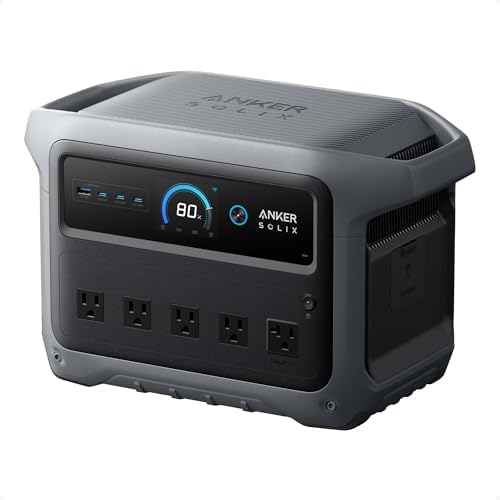
- 49 Min UltraFast Recharging: With upgraded HyperFlash tech, fully recharge at 1,600W—for outage prepping, camping trips,…
- 2,000W Output via 10 Ports: Delivers 2,000W (3,000W peak) and 1,024Wh capacity. Power up to 10 devices—ideal for emergen…
- Compact and Portable: Easily carry, store, and move from room to room, your RV, or even on beach and park outings. C1000…
Frequently Asked Questions
What does watt-hours mean in practical terms?
A watt-hour is one watt drawn for one hour. A 500 watt-hour station can run a 50 watt device for roughly ten hours, minus conversion losses. Phone batteries are usually listed in milliamp-hours; a typical phone holds about 15 to 20 watt-hours, so a 500 watt-hour station is roughly 20 phone charges.
Do I need a power station or just a battery bank?
If everything you charge is USB, a bank is lighter, cheaper, and enough. A power station earns its price when you need a wall outlet for something like a CPAP machine, a fridge, or camera batteries with a proprietary charger.
How much does cold weather reduce capacity?
Lithium chemistry loses noticeable capacity below freezing, and many stations will refuse to charge at all when very cold, though they will usually still discharge. In winter, plan on roughly 20 to 30 percent less usable capacity and keep the unit inside an insulated bag or in the vehicle overnight.
LiFePO4 or standard lithium-ion?
Lithium iron phosphate lasts far longer, typically thousands of cycles instead of hundreds, and handles heat better. It is heavier for the same capacity. For anything you plan to keep for years, it is the better buy.
Can I recharge it from my car?
Yes, but slowly on a standard 12 volt socket, often 100 watts or less, which means many hours for a large unit. Some stations support faster charging through a dedicated alternator connection. Check before assuming a day of driving will refill it.
Is a bigger inverter better?
Only if you need it. The inverter rating is the maximum instantaneous draw, so a coffee maker or kettle may exceed a small station regardless of its capacity. Check the surge and continuous watt ratings against the highest-draw thing you plan to plug in.

Written by Jake Miller · Camping & Gear
Jake grew up pitching tents before he could drive and has spent 15+ years camping, car-camping, and gear-testing his way across the country. If it can be cooked over a fire or packed into a trunk, he has an opinion on it.