
Heads up: this post contains affiliate links. If you buy through one, we may earn a small commission at no extra cost to you. As an Amazon Associate, we earn from qualifying purchases.
⚡ Quick Answer: For most trips, airplane mode plus a 10,000 milliamp-hour battery bank covers three to five days of navigation and photos. Turn off cellular searching, keep the phone warm at night, and charge from the bank in one sitting rather than topping up constantly. Solar only makes sense past about a week out.
There are two ways to run out of phone battery on a backpacking trip. One is using it too much. The other, far more common, is letting it drain while it sits in your pack doing nothing useful. Fixing the second problem is free, and it usually solves the whole thing.
The settings that matter, in order of impact
- Airplane mode, always. Out of coverage, your phone searches for a tower continuously and that search is one of the biggest drains available. GPS still functions in airplane mode, so offline navigation is unaffected.
- Download maps before you leave. Offline map regions in your navigation app of choice, downloaded on home wifi. This also stops the app from trying to fetch tiles it cannot reach.
- Screen brightness down, auto-lock short. The screen is the second largest consumer. Thirty seconds to auto-lock is plenty.
- Turn off background app refresh and non-essential notifications. Nothing needs to sync in the backcountry.
- Stop continuous GPS tracking unless you genuinely want the track. Recording a route all day costs far more than checking your position a dozen times.
Do those five things and a modern phone will often go two full days on its own battery with normal navigation use. That is the baseline you should be sizing a bank against.
Sizing the battery bank
A typical phone battery holds somewhere between 15 and 20 watt-hours, which is roughly 4,000 to 5,000 milliamp-hours at the phone battery voltage. Bank capacity is advertised at cell voltage, and conversion losses eat 20 to 35 percent of it, so a 10,000 milliamp-hour bank delivers about three to four real phone charges, not the five the box implies.
- Weekend, two nights: no bank needed if you manage settings, or a small 5,000 milliamp-hour unit for comfort.
- Three to five days: one 10,000 milliamp-hour bank. This is the sweet spot for weight versus capacity.
- Five to eight days: 20,000 milliamp-hours, or two 10,000 units so a failure does not strand you.
- Longer, or with a satellite messenger and headlamp to feed: 20,000 plus a resupply plan.
Look for USB-C in and out, and check the output wattage. A bank that only outputs 5 watts will take most of a night to fill a phone. Around 18 to 20 watts is the practical target.
Charge in one sitting, not in dribbles
Every time you plug in and unplug, you pay a conversion penalty. Plugging in for ten minutes here and there wastes a surprising amount of a bank. Better practice: let the phone drop to around 20 percent, then charge it back up in a single session, ideally in the tent at night when the phone is warm and you are not using it.
Keep both the phone and the bank inside your sleeping bag on cold nights. A bank that has been at 20 degrees will refuse to deliver its rated capacity, and some will refuse to charge a device at all until they warm up.
When solar earns its weight
A folding panel large enough to actually charge a phone in real conditions weighs roughly what a second battery bank weighs, costs more, and depends on weather and on you remembering to orient it. For a trip under a week, carry the second bank instead. Past a week, or on desert and alpine routes with reliable sun and no resupply, solar starts to win because it is the only option that does not run out.
If you are weighing it up, our solar charger guide covers what actually works, and the solar watts calculation explains how much panel you need for a given load. For car camping the answer is different again, and usually a portable power station sized with this method.
Do not let power become a safety problem
The reason any of this matters is that a dead phone is a lost map and a lost way to call for help. If your safety plan depends on the phone, build in redundancy: a paper map and compass you can actually use, and if you are going somewhere without coverage, a satellite messenger with its own battery. And if you hike alone, read the solo hiking guide, because power management is a bigger deal when nobody else is carrying a backup.
A pre-trip checklist
- Bank charged to full the night before, verified on the display rather than assumed.
- Offline maps downloaded and opened once to confirm they render without signal.
- Cable tested with both the phone and the bank, and a spare short cable packed.
- Phone case that lets you charge without removing it.
- Airplane mode on before you leave the trailhead, not after you notice the drain.
None of that is exotic. It is just the difference between having a working phone on day four and carrying a brick.
Recommended Gear

- Dust/Water Resistant Charging Brick: Our portable power bank is rated IP67 for dust and water resistance when port cover…
- Fast-Charging Backup Battery: Equipped with Type C PD and Quick Charge USB A ports to charge multiple devices rapidly, t…
- Travel Convenient Phone Power Bank: The power pack’s integrated utility carabiner loop works perfectly on your work belt…
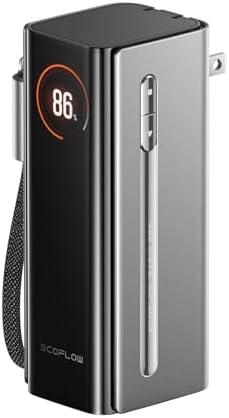
- 67W Fast Charging. Delivers powerful 67W high-speed charging for laptops, smartphones, tablets and more. Two USB-C ports…
- 3-in-1 All-in-One Design. Integrates a 10,000mAh power bank, a foldable AC plug, and a detachable USB-C cable in one com…
- Ultra-Compact & Lightweight. Weighs only 13 oz and measures 1.7 x 1.5 x 4.5 in. Its slim, portable body slides easily in…

- 10000mAh Real Capacity + Smart LED Display: Go all day without hunting for an outlet. 10000mAh provides 1.5–2 full charg…
- 5-in-1 Built-in Cables (USB-C & Lightning) – Never Forget Wires Again:Say goodbye to tangled cables and “low battery anx…
- 20W Ultra-Fast & High-Density Slim Design:Stop waiting all day for your phone to charge. Our upgraded 20W USB-C Output d…

- 87W Power to Share: Distribute 87W across three devices, with a single device receiving up to 65W, to rapidly charge iPh…
- Speedy Cable Charging: Utilize the built-in cable to elevate your iPhone 15 Pro to 58% or a MacBook Air to 52% in 30 min…
- 20,000mAh for Extended Use: Eliminate concerns about battery depletion with a 20,000mAh power bank that ensures consiste…
Frequently Asked Questions
How many days will a 10,000 mAh bank last?
Roughly three to five full phone charges, so three to five days if you use the phone for navigation and photos with cellular off. Heavy GPS tracking or video shortens that considerably. Cold cuts it further.
Does airplane mode really help that much?
Yes, more than almost anything else. A phone with no signal will burn battery hunting for a tower continuously, and that search is one of the largest drains there is. GPS still works in airplane mode, so offline maps are unaffected.
Why does my phone die faster in the cold?
Lithium batteries deliver less usable capacity at low temperatures, and the phone may shut down while still holding charge. Keep it in an inside pocket during the day and inside your sleeping bag at night, and it will often recover most of that apparent loss.
Is a solar panel worth carrying?
For trips under about a week, no. A panel that meaningfully charges a phone weighs about the same as another battery bank while depending on weather and requiring you to fuss with it. Past a week, or on trips with long open exposure, the math flips.
Should I bring a second phone or a dedicated GPS?
A dedicated GPS unit runs on replaceable batteries, which is a real advantage on long trips. For most people a phone with offline maps plus a paper map and compass is enough, and the redundancy is better spent on the paper.
Do fast chargers hurt the battery?
Fast charging generates heat, which is the actual enemy of battery longevity. For trail use it is fine. Charging a hot phone in direct sun is the thing to avoid.

Written by Jake Miller · Camping & Gear
Jake grew up pitching tents before he could drive and has spent 15+ years camping, car-camping, and gear-testing his way across the country. If it can be cooked over a fire or packed into a trunk, he has an opinion on it.