
Heads up: this post contains affiliate links. If you buy through one, we may earn a small commission at no extra cost to you. As an Amazon Associate, we earn from qualifying purchases.
⚡ Quick Answer: Assume a solar panel delivers about half its rated wattage in real camping conditions, and only for four to six useful hours a day. A 100 watt panel therefore returns roughly 200 to 300 watt-hours on a good day. For USB devices only, 20 to 40 watts is plenty. For a power station running a fridge, plan on 100 to 200 watts.
Solar panel marketing has one systematic distortion: the wattage on the box is a laboratory number. It is not a lie, but it describes conditions you will never camp in. Once you adjust for reality the sizing question gets much easier, because you stop comparing panels and start comparing daily watt-hours.
The two corrections that make the math honest
Take the rated wattage and apply both of these.
- Halve it. Panel cells lose efficiency as they heat up, which they always do in sun, and your angle to the sun is rarely ideal. Fifty percent of rated output is a sound planning assumption for a well-placed panel on a clear day.
- Multiply by four to six hours, not by daylight hours. Production is heavily weighted toward the middle of the day. Sunrise and sunset contribute almost nothing.
So a 100 watt panel becomes roughly 50 watts for five hours, which is about 250 watt-hours a day. A 200 watt panel gives about 500. A 25 watt folding USB panel gives you something like 60 to 70 watt-hours, which is three or four phone charges. Those are the numbers to plan with.
Match the panel to what you are filling
USB devices only
Phones, headlamps, a satellite messenger, maybe a tablet. Total daily need is usually under 60 watt-hours. A 20 to 40 watt folding panel with USB output covers it, and honestly a second battery bank often covers it better for less fuss. See keeping a phone charged while backpacking for the weight comparison.
A power station for car camping
Here the panel needs to keep pace with a real load. If you have sized your station properly using the watt-hour method, you already know your daily consumption. Divide that by 250 to get roughly how many hundred-watt panels you need.
- 250 watt-hours a day, lights and phones and a laptop: one 100 watt panel keeps up.
- 400 to 500 watt-hours a day, adding a fan or camera gear: 200 watts of panel.
- 600 watt-hours and up, compressor fridge in hot weather: 200 to 400 watts, and accept that overcast days will draw down the battery.
Check the station input limit before buying panels. Many mid-size units cap solar input at 200 watts regardless of what you connect, so a third panel does nothing.
Placement is worth more than extra wattage
A well-aimed 100 watt panel routinely outproduces a lazily propped 200 watt panel. Three habits capture most of the available gain.
- Aim the panel perpendicular to the sun, and reposition it two or three times through the day.
- Keep it completely out of shade, including thin shade from guy lines and branches, and watch how shadows move.
- Get air under it so it stays cooler, and keep the connected battery in shade even while the panel sits in sun.
One practical note on cabling: voltage drop over a long thin extension cable is real. If you are running the panel out to a sunny clearing while the battery stays at camp, use a thicker cable than feels necessary.
When solar is the wrong answer
Solar is a poor fit for short trips, forested campsites, and anywhere your schedule has you hiking during the productive hours. In all three cases another battery is cheaper, lighter, and more reliable. Solar wins when you are stationary, in the open, and out long enough that stored capacity would run dry. Our solar charger roundup and power station comparison cover which specific units are worth the money.
Test it in the driveway first
Set the panel up at home on a clear day, connect it to whatever it is meant to charge, and watch the input reading for an hour. You will learn your real-world number, which is the only one that matters, and you will find out whether your connectors and adapters actually fit before you are three hours from a hardware store.
Recommended Gear

- 25% High Conversion Efficiency: Powered by advanced N-Type solar cells, this portable solar panel generates more energy …
- Fiberglass Reinforced Durability: Designed with a fiberglass layer to help resist cracking, our foldable solar panel sta…
- 200 Watt Solar Panel with Plug-and-Play Compatibility: Includes XT60 and DC7909 connectors for quick and easy setup with…

- 【23.5% High-Efffciency A+ Monocrystalline Cells】Constructed with premium Grade A+ silicon cells, this 100W solar panel o…
- 【True 5-in-1 Universal Connectivity】 Unlike standard 4-in-1 cables, our upgraded solar cable features 5 distinct connect…
- 【IP67 Waterproof ETFE Coating】 Designed for the unpredictability of outdoor life. The advanced ETFE lamination offers su…

- [Wide Application] 800Wh daily output depends on the 4 hours sunlight availability; suited for applications that require…
- [Excellent Performance] 22% High solar cell efficiency; Corrosion-resistant aluminum frame for outdoor use, allowing the…
- [Multiple Protection] The Renogy Adventurer-Li 30A PWM charge controller is designed for aesthetically clean flush mount…
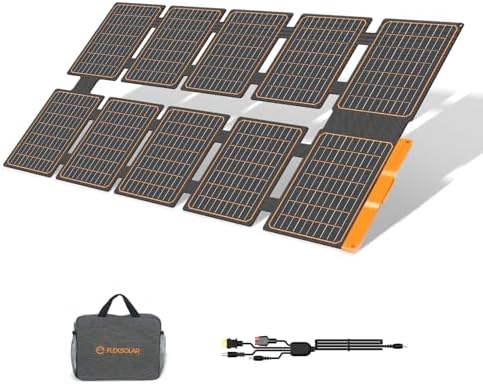
- 【Ultra-Portable & 4.1Lbs Lightweight】Foldable to 12.99×10.43×2.17inches (laptop-sized!) and weighs only 4.1lbs(1.85kg) –…
- 【Wider Compatibility & 4-in-1 Smart Cable】Works with Jackery, EcoFlow, Bluetti, Anker, ALLWEI and 99% of power stations …
- 【24% High Efficiency & Smart Protection】The energy conversion efficiency of solar panels can reach up to 24%, generating…
Frequently Asked Questions
Why does my 100 watt panel only produce 50 watts?
Rated wattage is measured under standard test conditions: full perpendicular sun, 25 degrees Celsius cell temperature, and clear air. Real panels get hot, sit at imperfect angles, and see haze and thin cloud. Half of rated output is a realistic planning figure, and it can be far less in shade or overcast.
How many hours of sun should I count on?
Four to six hours of genuinely useful production per day in summer, even though the sun is up much longer. Early and late sun hits the panel at a steep angle and produces very little. Repositioning the panel two or three times a day meaningfully improves the total.
Can I charge a power station and use it at the same time?
Yes, most units pass through power while charging. The catch is that the load subtracts from the charging, so if your fridge draws 45 watts and your panel is producing 50, you are barely gaining ground.
Do panels work through clouds?
They produce something, typically 10 to 25 percent of rated output under heavy overcast, and rather more under thin high cloud. It is not zero, but it is not a plan. Never size a system on the assumption that every day is sunny.
Rigid, folding, or flexible?
Folding suitcase-style panels are the practical choice for camping because they store flat and have built-in stands. Rigid panels are cheaper per watt but awkward. Flexible panels are convenient to mount but generally less durable and less efficient.
Does panel shading matter if it is only partial?
A great deal. A shadow across even one cell can disproportionately reduce output for the whole panel, depending on its internal wiring. Site the panel where no branch or tent guy line will cross it as the sun moves.

Written by Jake Miller · Camping & Gear
Jake grew up pitching tents before he could drive and has spent 15+ years camping, car-camping, and gear-testing his way across the country. If it can be cooked over a fire or packed into a trunk, he has an opinion on it.