
Heads up: this post contains affiliate links. If you buy through one, we may earn a small commission at no extra cost to you. As an Amazon Associate, we earn from qualifying purchases.
⚡ Quick Answer: Plan on about half a litre per hour of moderate hiking in mild weather, rising toward a litre per hour in heat, at altitude, or on steep climbs. For a four hour day hike in summer that is two to three litres. Always add a reserve of at least half a litre, and confirm any water source you are counting on is actually running before you rely on it.
Carrying too little water is dangerous and carrying too much is exhausting, since every litre is about a kilogram on your back. The good news is that the estimate does not need to be clever. A simple hourly rate with a few honest adjustments gets you close enough almost every time.
The base rate
Half a litre per hour of moderate hiking in mild weather. That is the anchor. For a typical four hour day hike in comfortable conditions, two litres plus a small reserve.
The four adjustments that matter
- Heat: above roughly 25 degrees Celsius, move toward three quarters of a litre per hour. In genuine desert heat, a litre per hour is realistic and shade breaks matter as much as volume.
- Altitude: above about 2,500 metres you lose more water through faster breathing and drier air, and you will not feel as thirsty. Add roughly a quarter more than you would at sea level.
- Effort: sustained steep climbing with a heavy pack can double consumption compared to a flat walk over the same hours.
- Refill options: a route with a reliable stream every few kilometres means you carry a litre and a filter rather than four litres. This is the single biggest lever on pack weight.
Add those up rather than picking the largest. A hot climb at altitude is genuinely a litre-per-hour day, and pretending otherwise is how people end up rationing.
Always carry a reserve
Whatever the calculation says, add at least half a litre you do not plan to drink. It covers the wrong turn, the longer-than-expected descent, the dry spring, and the person in your group who brought one small bottle. On multi-day trips make that reserve a full litre.
Filtering instead of carrying
On a route with confirmed water, a filter is the best weight saving in hiking. Carry a litre, drink it, refill. The two conditions are that the sources genuinely exist, verified recently rather than from a map printed years ago, and that you are willing to stop.
Be conservative about what you treat. Assume all backcountry surface water needs treatment, including clear fast-moving mountain streams, and treat water taken downstream of grazing, trails, or campsites with particular care. Where wildlife concentrates around water, there is a second consideration too, covered in wildlife safety by region.
How you carry it changes how much you drink
Two litres you cannot reach while walking is functionally less water than one litre on a hose. If you consistently return from hikes with water left over and a headache, the problem is access, not volume. That is the core argument in hydration bladder vs water bottle, and it is worth reading before you buy more capacity.
For pack choices that make water reachable, see our hydration pack guide. For winter, insulated bottles are the only reliable answer, covered in the insulated bottle roundup.
Winter is not a rest from hydration
Cold-weather dehydration is common and sneaky. You sweat under layers, you breathe out moisture in dry air, and you do not feel thirsty. People routinely drink half what they should on winter hikes and attribute the resulting headache and fatigue to the cold. Carry insulated bottles, drink on a schedule rather than on thirst, and treat a warm drink at breaks as part of the plan.
A worked example
Ten kilometre loop, 500 metres of climbing, expected four and a half hours, forecast 28 degrees, one stream at the halfway point that a trip report from last week confirms is running. Base rate at four and a half hours is 2.25 litres, adjusted up for heat to about three litres, plus half a litre of reserve. Because the stream is confirmed, carry two litres and a filter rather than three and a half litres. That is roughly a kilogram and a half saved, which you will feel on the climb.
Recommended Gear

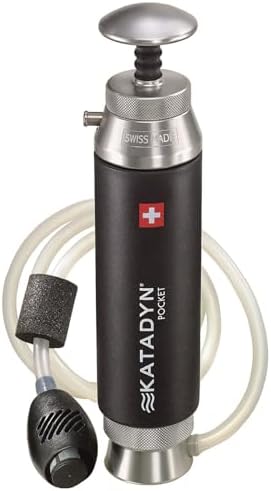
- Removes Bacteria & Parasites: The Microfiltration Membrane Removes 99.999999% of Waterborne Bacteria (Including E. Coli …
- Removes Microplastics: Removes the Smallest Microplastics Found in the Environment (Down to 1 Micron), and Reduces Turbi…
- Rigorous Testing: All Claims Are Verified with Laboratories Using Standard Testing Protocols Set by the US EPA, NSF, AST…

- FILTRATION YOU CAN TRUST: Removes 99.999999% of bacteria (including E. coli + Salmonella), 99.999% of parasites (includi…
- BUILT FOR EXTREMES: Durable, leak-proof materials stand up to drops, pressure, and rugged conditions
- VERSATILE HYDRATION: Can also be attached to water bottles and to standard gravity hoses with removable threaded bottom …
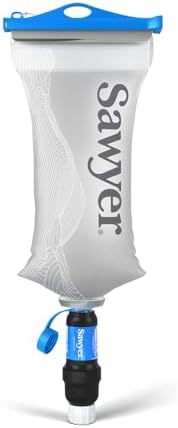
- Lightweight, easy to use portable water filter removes harmful bacteria, protozoa, cysts, sediment, And 100% of micropla…
- The Sawyer Squeeze Filter is reusable and easy to clean, lasting up to 100,000 gallons. The fiber walls inside Sawyer’s …
- The Cnoc 2 liter (64 ounce) bladder is made from extra-durable TPU with a wide mouth opening for fast, easy filling.
Frequently Asked Questions
Is a gallon a day the right rule?
A gallon, about 3.8 litres, is a reasonable full-day figure for hot-weather hiking and a considerable overestimate for a cool spring morning. Use the hourly rate and your actual conditions instead of a fixed daily number.
What are the early signs I am behind on water?
Dark urine, a headache, unusual irritability, and a heart rate that feels high for the effort. Thirst is a late signal, not an early one. If you notice any of these, stop and drink deliberately rather than sipping and pressing on.
Do I need electrolytes or just water?
For hikes under a couple of hours, plain water is fine. Beyond that in heat, or if you sweat heavily and notice salt on your skin and clothing, electrolytes help you retain what you drink. Drinking large volumes of plain water while sweating hard can dilute your sodium, which makes you feel worse rather than better.
Can I count on streams marked on the map?
Not without checking. Seasonal streams and springs shown on maps run dry, and late summer is exactly when you would need them. Check a recent trip report or a land manager update, and carry enough to reach the next reliable source if the first one has failed.
Should I carry a filter instead of more water?
Often yes, and it is the biggest weight saving available on a route with reliable water. A litre weighs about a kilogram, and a filter weighs a fraction of that. The trade is that you have to stop to filter, and you have to be confident the sources exist.
How much water does a dog need?
Roughly the same order of magnitude as a person for a medium to large dog on a warm day, and dogs cannot tell you they are struggling. Carry for them explicitly rather than assuming they will drink from puddles, and watch for heavy panting that does not settle at rest.
Written by Jake Miller · Camping & Gear
Jake grew up pitching tents before he could drive and has spent 15+ years camping, car-camping, and gear-testing his way across the country. If it can be cooked over a fire or packed into a trunk, he has an opinion on it.