
Heads up: this post contains affiliate links. If you buy through one, we may earn a small commission at no extra cost to you. As an Amazon Associate, we earn from qualifying purchases.
⚡ Quick Answer: A camping sleeping pad is insulated, packs small, and works in cold weather. A household-style air mattress is thicker and more comfortable but has almost no insulation, so it feels cold below about 15 degrees Celsius and is far too bulky to carry. Use a pad for anything you walk to or any cool night; use an air mattress only for warm-weather car camping close to the vehicle.
People buy an air mattress for their first camping trip because it is the obvious thing, it is comfortable at home, and it is cheap. Then they spend a cold night on it and conclude that camping is uncomfortable. The mattress was the problem, and specifically the fact that it is not insulated.
The difference is convection, not thickness
A household-style air mattress is a big open bag of air. Your body warms the top surface, that warm air rises and moves, it cools against the bottom, and it circulates continuously, ferrying your heat down into the ground all night. Thickness does not help, because more air simply means a bigger convection loop.
Camping sleeping pads exist to stop that. Some fill the space with open-cell foam, some use internal baffles and reflective film, some use down or synthetic insulation inside. All of it is there to hold the air still. That is why a three-centimetre insulated pad can be dramatically warmer than a twenty-centimetre air mattress.
The way that performance gets quantified is R-value, and it is worth understanding before you buy anything. We break it down in sleeping pad R-value explained.
When an air mattress is the right call
- Warm-weather car camping, nights staying above roughly 15 degrees Celsius.
- Festival or event camping where you drive in and comfort beats everything.
- Overflow sleeping for guests at home, which is what these are actually designed for.
- Camping with someone who genuinely cannot sleep on a firm surface, with a foam pad added on top for warmth.
If that describes your camping, an air mattress is fine and you do not need to overthink it. Just bring a foam layer or a thick blanket to put on top of it, and expect a pump.
When you need a proper pad
- Any night below about 15 degrees Celsius. This includes most spring and autumn nights, and most summer nights at altitude.
- Anything you carry. A pad packs to the size of a water bottle; a mattress does not pack at all.
- Anywhere the ground is rough or frozen. Pads are tougher and field-repairable.
- Any trip where being cold would be a safety problem rather than just unpleasant.
The three kinds of camping pad
- Closed-cell foam: a solid foam mat. Cheap, indestructible, cannot deflate, modest comfort. Excellent as a second layer under an inflatable and as winter backup.
- Self-inflating: foam inside a shell that draws air in when you open the valve. Comfortable, warm, durable, heavier and bulkier. A great car-camping and general-purpose choice.
- Insulated air pads: baffled air construction with internal insulation. Lightest and most compact for a given warmth, thickest for comfort, and the most vulnerable to punctures. The standard for backpacking.
For most people the honest recommendation is one self-inflating or insulated air pad in the 3 to 4.5 R-value range plus a cheap foam pad, which together handle nearly everything. Current options are compared in our sleeping pad guide.
Do not fix a cold pad with a warmer bag
It is tempting, and it does not work well, because your weight crushes the insulation underneath you regardless of how good the bag is. If you have been cold at night, look down before you look up. Bag ratings are their own confusing topic, handled in sleeping bag temperature ratings and how to choose a sleeping bag.
Small habits that matter more than the spec
- Clear the site properly. Ten seconds of removing stones and cones beats any amount of padding.
- Inflate firm, then let a little air out until your hip does not bottom out when you press down hard.
- Top up in the night if the temperature drops, because cooling air loses pressure.
- Carry the patch kit and know where it is, in the dark, without unpacking everything.
- Put a groundsheet or footprint under the tent floor to protect the pad from sharp debris.
Recommended Gear
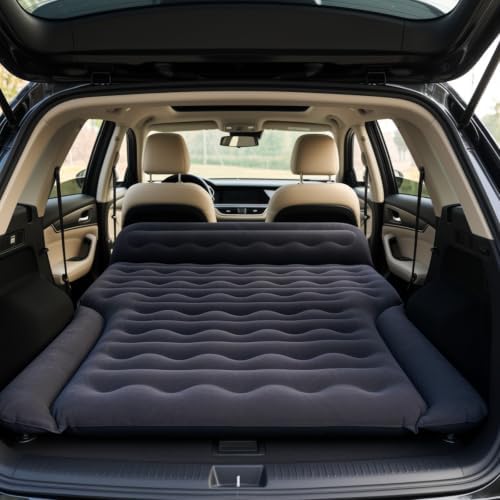
- 【DESIGNED FOR SUV TRUNKS & MINIVANS】Transform your vehicle’s cargo area into a comfortable sleeping space with this SUV …
- 【THICKENED COMFORT WITH BUILT-IN HEAD SUPPORT】Enjoy a comfortable sleeping experience with a soft flocked surface and wa…
- 【LEAK-RESISTANT & DURABLE CONSTRUCTION】Built for reliable outdoor adventures, this SUV mattress features reinforced PVC …
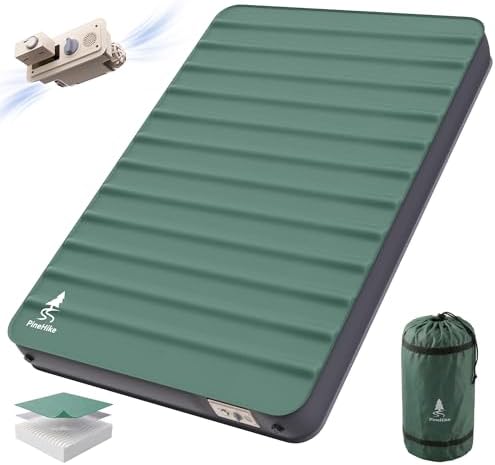
- Upgraded Sponge Designed for Ultimate Comfort – Compared to traditional sleeping pads, This high resilience cut 50D spon…
- One-Button Start,Quick to Inflate& Deflate, Easy to Store – PineHike self inflating sleeping pads cot features a built-i…
- Rechargeable and Removable Smart Charging Pump – Our portable pump features a high-capacity powerful battery, delivering…

- 3″ ADVANCED FOAM SUPPORT FOR ALL SLEEP POSITIONS ☛Upgrade your outdoor sleep with the comfort of high-density foam. This…
- SELF-INFLATING + FOOT PUMP FINE-TUNE ☛ After opening the valve, the foam naturally expands to draw in air. The built-in …
- DURABLE FABRIC & NON-SLIP BASE ☛ The camping air mattress is constructed with abrasion-resistant nylon fabric designed f…

- Upgraded 6″ Thickness for Ultimate Comfort — Enjoy the comfort of an inflatable sleeping pad with a 6″ thick pad (79″ x…
- Easy Inflation with Foot Pump — Effortlessly inflate the camping pad by stepping on the built-in foot pump. Dual-layer …
- Lightweight and Space-Saving — Despite its double size, this sleeping pad weighs only 2.4 lbs and packs down to a compa…
Frequently Asked Questions
Why is an air mattress so cold?
Because it is a large volume of air with nothing to stop that air circulating. Warm air rises off the top surface, cools against the bottom, and convects around inside, continuously carrying your body heat down to the ground. Insulated pads use internal baffles, foam, or reflective film specifically to stop that circulation.
Can I make an air mattress warmer?
Yes. Put a closed-cell foam pad or thick blankets on top of it, between you and the surface. Adding blankets underneath the mattress helps much less, because the problem is convection inside the mattress rather than conduction below it.
Is a self-inflating pad the same as an air mattress?
No. Self-inflating pads contain open-cell foam that both draws air in and blocks convection, which is why they insulate well. They are heavier than pure air pads of the same thickness but very durable and forgiving.
What about a cot?
A cot gets you off uneven or wet ground and is comfortable, but it puts moving air underneath you, so it still needs a pad on top in cool weather. Cots are bulky and are strictly a car camping item.
How thick does a pad need to be for a side sleeper?
Aim for around 7.5 centimetres, roughly three inches, or more. Side sleeping concentrates weight at the hip and shoulder, and a thin pad lets those points bottom out onto the ground, which is both uncomfortable and cold.
Do air mattresses leak more than pads?
Both can puncture, but household air mattresses tend to fail at seams under repeated flexing, and they are usually not field-repairable. Camping pads generally come with a patch kit and are designed to be fixed on the trip.

Written by Jake Miller · Camping & Gear
Jake grew up pitching tents before he could drive and has spent 15+ years camping, car-camping, and gear-testing his way across the country. If it can be cooked over a fire or packed into a trunk, he has an opinion on it.