
Heads up: this post contains affiliate links. If you buy through one, we may earn a small commission at no extra cost to you. As an Amazon Associate, we earn from qualifying purchases.
⚡ Quick Answer: To catch crappie: fish a 1/16 oz jig or a minnow under a bobber around brush piles, dock pilings, and standing timber, 5–15 feet deep. Spring spawn (water 55–65°F) pushes them shallow and easy; the rest of the year, find the cover and you find the school. Ultralight gear and 4 lb line double your bites.
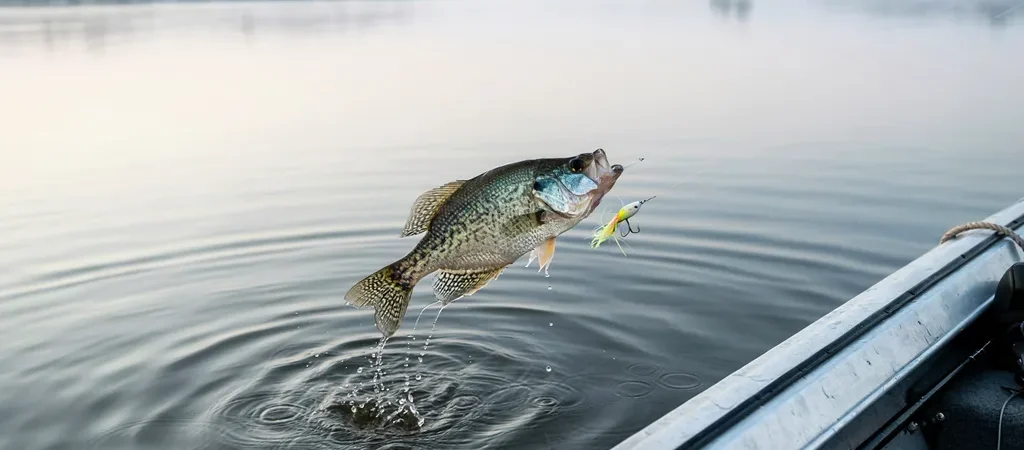
Crappie might be the perfect fish: they school up (find one, find fifty), they live in nearly every reservoir and pond, they bite tiny lures with enthusiasm, and they’re arguably the best-tasting freshwater fish in America. Here’s the simple system for a livewell full of slabs.
Crappie 101
Two species — black crappie (clearer water, more cover-oriented) and white crappie (murkier water, more open) — and one strategy: crappie relate to structure and suspend. They hover around brush piles, dock pilings, bridge columns, and flooded timber at very specific depths. Your job is finding the right cover at the right depth, not covering water.
The Two Presentations That Matter
- The jig (1/32–1/16 oz): tube or curly-tail plastics on a light jighead. Cast past the cover, count it down, and retrieve painfully slow — or just hold it still (“dead-sticking”). Crappie bites are soft; watch the line.
- Minnow under a slip bobber: the classic for a reason. Set the bobber to hold the minnow just above the fish and let it do the work. Perfect for kids and dock fishing.
Finding Crappie by Season
- Spring (the easy season): water 55–65°F sends crappie into shallow coves and brush to spawn — bank anglers catch limits.
- Summer: schools slide deeper (10–20 ft) onto brush piles and channel edges; early and late are best.
- Fall: follow the bait into creek arms; crappie feed up all autumn.
- Winter: deep and tight to cover, but they still bite a slow jig — and winter crappie fry up best of all.
Light Gear = More Fish
Ultralight rod, 1000–2000 size reel, 4 lb line — crappie have paper mouths and soft bites, and light gear detects both. A jig assortment covers every day of the year:

- 【Unique Design】 All of these jig heads have unique 3D eyes, making them so attractive to most species of fish. Bright co…
- 【V Shape Hook】It’s sharp hook, making it penetrate the fish very quickly. And the high carbon steel makes it very hard t…
- 【Install Bait Firmly】: Fishing jig heads are equipped with bait keeper to securely hold your live bait or soft plastic l…

- 135 pieces fishing fixture head kits including fixture head hooks: 25 pieces 1/32 oz, 20 pieces 1/16 oz, 10 pieces 1/8 o…
- The jig hook has a sharp hook tip, corrosion resistance, and is not easily deformed. The barb can effectively prevent fi…
- The bait is made of high-quality materials, soft and resistant to biting, with a natural swimming posture and realistic …
Landing and Keeping
- Reel smooth and steady — “papermouth” is earned; hooks tear out under jerky pressure.
- A long-handled net saves the big slabs at the boat or dock.
- Crappie limits are generous in most states; selective harvest (keep the 9–12 inchers, release the giants) keeps a lake producing.
Pair this with our reel guide for the right ultralight, our pier fishing basics, and teaching kids to fish — crappie are the ultimate kid fish.
Frequently Asked Questions
What is the best bait for crappie?
Live minnows are the classic — hook one through the back under a slip float. Among artificials, a 1/16-ounce jig with a small tube or curly-tail grub in chartreuse or white is every crappie angler’s workhorse.
What depth do you fish for crappie?
Crappie suspend around structure — brush piles, standing timber, dock pilings — often 8 to 15 feet down. Start shallow in spring spawning season (2 to 6 feet near cover) and follow them deeper in summer and winter.
When is the best time to catch crappie?
Spring is prime, when spawning pushes fish shallow and they bite aggressively. Early morning and evening are best daily windows, and crappie also feed actively under lights at night, especially in summer.
Written by Tom Rivera · Fishing & Hunting
Tom has spent four decades outdoors — on lakes, rivers, and treestands — and still fishes most weekends. These days his favorite catch is watching his grandkids reel in their first bluegill.