
Heads up: this post contains affiliate links. If you buy through one, we may earn a small commission at no extra cost to you. As an Amazon Associate, we earn from qualifying purchases.
⚡ Quick Answer: To catch walleye: fish low light (dawn, dusk, night, or windy “walleye chop” days), work jigs tipped with minnows or crawler harnesses along bottom structure at 10–30 feet, and troll crankbaits to cover water. Walleye follow the light level — shallow when it’s dim, deep when it’s bright.
Walleye are the moody royalty of northern lakes — famously finicky, famously delicious, and famously tied to light. Crack the light-level code and the “fish of 10,000 casts” reputation evaporates. Here’s the practical version of walleye fishing, minus the mystique.
The One Rule: Follow the Light
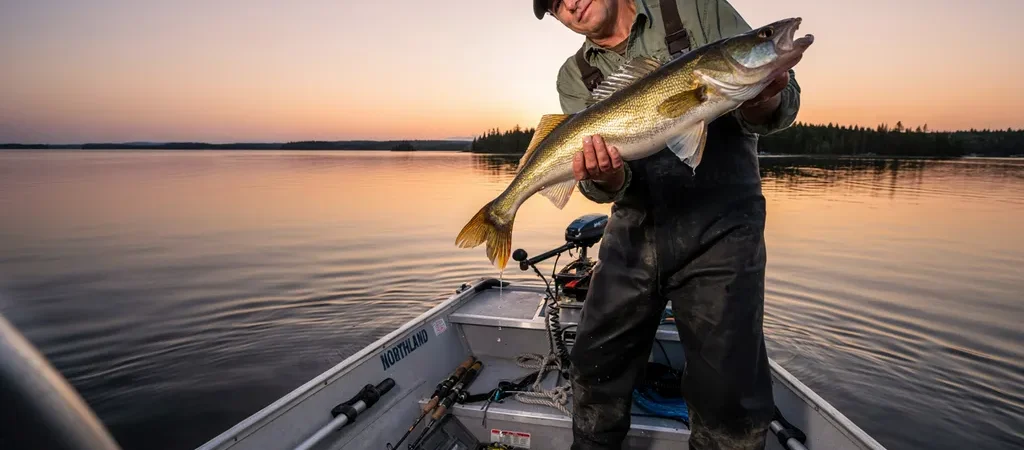
Walleye have reflective eyes built for hunting in the dark (that’s the glow in photos). Bright sun pushes them deep or tight to shade; dim light brings them shallow to feed. This single fact organizes everything: fish dawn/dusk/night, love overcast days, and celebrate wind — the surface chop scatters light and turns walleye on midday (“walleye chop” is real).
Three Techniques That Cover Everything
- Jig + minnow: the classic. A 1/8–3/8 oz jig tipped with a fathead or shiner, hopped slowly along bottom on points and drop-offs. Most walleye ever caught, caught this way.
- Crawler harness: a spinner-and-beads rig trailing half a nightcrawler, drifted or slow-trolled along contours with a bottom-bouncer weight. Summer’s workhorse.
- Trolling crankbaits: minnow-profile baits pulled along breaklines to find scattered fish — then circle back and jig the school.
Where They Live
- Rock points and gravel bars: classic spawn-and-feed structure.
- Breaklines: the edge where flats drop to deep water — walleye commute along them like highways.
- Weed edges: summer walleye tuck into cabbage weed more than most anglers think.
- Current: river walleye stack below dams and in eddy seams, especially spring and fall.
Feel the Bite (It’s Subtle)
A walleye bite is usually just… weight. A tick, a heaviness, the jig not falling right. When anything feels different, sweep the rod. Braid main line with a fluorocarbon leader telegraphs these soft bites far better than stretchy mono — our line guide covers the setup.
Starter Walleye Tackle

- Highly Attractive Design: walleye fishing lures are hand tied with vibrant Colorado spinners and glow beads featuring a …
- Spinner Performance: fishing spinners in this set are Colorado style generating super bright and intense vibrations to a…
- Abundant Quantity Kit: walleye rigs kit includes 15 pieces total with 5 different colors each having 3 rigs; Every rig c…

- Package Includes: 10pcs Minnow Fishing Lures; Length: 8.7cm/3.4in; Weight: 7.3g/0.3oz; 10 Colors Mixed; with Double Treb…
- Hard bait body is made of ABS material, which is impact and abrasion resistant, and is not easy to be damaged even if it…
- Nimble Swimming: Each lure contains flexible movable steel balls inside, and the unique center of gravity shifting desig…
Table Fare Notes
Walleye are the best-eating fish in fresh water — but slot limits protect the big spawning females on most good lakes. Keep the eaters (15–20 inches where legal), release the trophies, and check regs per lake. For trip planning, dawn patrol beats everything: be on the water before first light, and see our timing guide and night fishing tips.
Frequently Asked Questions
What is the best bait for walleye?
A jig tipped with a minnow is the year-round standard; leeches and nightcrawlers on live-bait rigs take over in summer. Among artificials, paddle-tail swimbaits and crankbaits trolled along breaklines produce consistently.
What depth do you find walleye?
Follow the light: shallow flats and shoreline breaks at dawn, dusk, and night; 15–30 foot structure at midday. Wind-blown points concentrate them — ‘walleye chop’ stirring the surface is a genuine green light.
Why are walleye so hard to catch?
They are light-shy, current-oriented, and subtle biters — the tap feels like a leaf. Fish low-light windows, slow down presentations, and watch your line where it enters the water. Once you learn their hours, they become almost predictable.
Written by Tom Rivera · Fishing & Hunting
Tom has spent four decades outdoors — on lakes, rivers, and treestands — and still fishes most weekends. These days his favorite catch is watching his grandkids reel in their first bluegill.