
Heads up: this post contains affiliate links. If you buy through them, WildMorrow may earn a small commission at no extra cost to you. As an Amazon Associate, we earn from qualifying purchases.
⚡ Quick Answer: The four essential fishing knots – improved clinch, Palomar, uni, and double uni – when to use each, and the three mistakes (dry cinching, too few wraps, long tags) that break them.
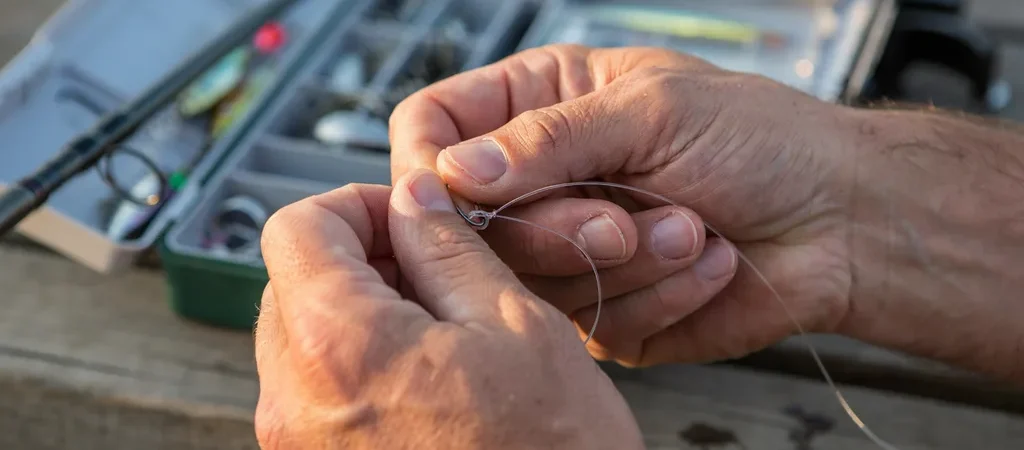
You can own the best rod on the lake, but if your knot fails, you lose the fish of the day and a lure to boot. The good news: you only need about four knots to handle ninety-nine percent of fishing situations, and each one takes ten minutes to learn on the couch. Here are the essential fishing knots every angler should know, when to use each, and the mistakes that make good knots fail.
1. The improved clinch knot (tie this first)
The workhorse for tying line to a hook, lure, or swivel. Pass the line through the eye, twist five to seven times, back through the loop by the eye, then through the big loop, and cinch. If you learn one knot this year, learn this. It handles the majority of everyday fishing.
2. The Palomar knot (the strongest, easiest)
Widely considered the strongest common knot and hard to tie wrong, which is why braid users swear by it. Double the line, pass the loop through the eye, tie a simple overhand, pass the hook through the loop, and cinch. Perfect for braided line, which can slip in other knots.
3. The uni knot (the versatile one)
One knot that does everything: tie to hooks, join two lines (as a double uni), and it holds beautifully. Many pros use the uni for nearly everything because the muscle memory transfers across tasks.
4. The double uni or blood knot (line to line)
You’ll need to join two lines the moment you add a fluorocarbon leader to braided main line, a setup that’s invisible to fish and abrasion-resistant. The double uni is the beginner-friendly choice for connecting them.
The three mistakes that break knots
Dry cinching: always wet the knot with saliva or water before you pull it tight, or friction heat weakens the line. Not enough wraps: too few twists and the knot slips; follow the count for each. Leaving a long tag: trim close, but never nick the main line with your clippers. A clean, wetted, properly wrapped knot is stronger than most people’s fishing.
Line and tools that make knots easier
Good knots start with good line: a quality braid for sensitivity and strength, a fluorocarbon leader for invisibility near the fish, and sharp clippers so your tags are clean, not frayed.

- Power Pro Original Spectra Braid Fishing Line 30lb 500yd Moss Green 30-500
- Power Pro Original Spectra Braid Fishing Line 30lb 500yd Moss Green 30-500
- Power Pro Original Spectra Braid Fishing Line 30lb 500yd Moss Green 30-500

- 100% pink fluorocarbon leader material disappears in most saltwater applications
- Unmatched abrasion and shock resistance in the saltwater world
- Superior knot strength, thin diameter and low memory are key traits

- Convenient Retractable Design: Features a built-in retractable mechanism for easy access and secure storage, perfect for…
- Precision Stainless Steel Blades: High-quality blades ensure clean and accurate cuts on all types of fishing lines, incl…
- Lightweight and Portable: Compact design fits easily into pockets, tackle boxes, or gear bags, making it an essential fi…
Practice, then go fishing
Tie each knot ten times at home tonight and they’ll be automatic on the water tomorrow. Then put them to work with our beginner’s fishing guide, choose the right lure with the bait and lures guide, and gear up from the best fishing gear roundup.
Frequently Asked Questions
What is the easiest fishing knot for beginners?
The improved clinch knot: thread, wrap five times, tuck, and wet before tightening. It takes an evening to make automatic and covers most hook, lure, and swivel connections a beginner will ever tie.
What is the strongest fishing knot?
The Palomar knot tests near 100 percent of line strength when tied correctly, and it is beautifully simple — double the line, overhand knot, loop over the hook. It is the go-to for braid and drop-shot rigs.
Why do my fishing knots keep breaking?
Almost always friction damage: tightening a dry knot generates heat that weakens the line. Wet every knot with saliva before cinching, pull it tight smoothly rather than jerking, and re-tie after every big fish or snag.

Written by Tom Rivera · Fishing & Hunting
Tom has spent four decades outdoors — on lakes, rivers, and treestands — and still fishes most weekends. These days his favorite catch is watching his grandkids reel in their first bluegill.