Heads up: this post contains affiliate links. If you buy through one, we may earn a small commission at no extra cost to you. As an Amazon Associate, we earn from qualifying purchases.
⚡ Quick Answer: For most beginners, a Garmin inReach Mini 2 is the safest default because it does two-way texting, has the largest global network, and works as a standalone device. ZOLEO is cheaper per month and easier to read on a phone but needs the app for messaging. SPOT is the budget entry point and is fine for pure SOS plus one-way check-ins, but it cannot hold a conversation.
If you have ever lost cell signal on a trail and felt that small drop in your stomach, you have already understood the entire pitch for a satellite messenger. These are small devices that talk to satellites instead of cell towers, so they work in canyons, on ridgelines, and in the middle of a national forest where your phone shows one bar of nothing.
The problem is that the three names you keep seeing, Garmin inReach, ZOLEO, and SPOT, get compared in reviews written for people who already know what a two-way message credit is. This guide is the version for someone buying their first one. If you want the wider field, our guide to the best satellite messengers covers more models; this page is about choosing between the three that matter most.
The one difference that actually decides it
Ignore the spec sheets for a minute. The real fork in the road is whether you want a device that can hold a two-way conversation on its own screen.
- Garmin inReach sends and receives text messages, and you can type them on the device itself with no phone involved. That matters when your phone is dead, wet, or buried in a pack.
- ZOLEO also sends and receives two-way messages, but you compose them in the ZOLEO app on your phone. The device is a relay with an SOS button.
- SPOT in its classic form is one-way: you send preset check-ins and an SOS, but you do not get replies. Newer SPOT models add limited messaging; the cheap ones do not.
If your honest use case is “I want someone to know I am fine, and a rescue button if I am not,” SPOT does that for the least money. If your use case includes “and I want to tell them what is actually going on,” you want inReach or ZOLEO.
Cost is mostly subscription, not hardware
Beginners fixate on the sticker price and then get surprised by the plan. Across all three brands the hardware is a one-time cost in the low-to-mid hundreds, and the plan is a monthly fee that scales with how many messages you want and whether you commit annually.
Two things to know before you buy. First, most plans have an activation fee, so hopping on and off every month costs more than it looks. Second, suspending a plan for the off-season is usually free or nearly so, which makes month-to-month the right choice for anyone with a real hiking season rather than year-round trips.
What each one is genuinely good at
- inReach: standalone operation, weather forecasts on demand, tracking that friends can follow on a map link, and the Iridium network. Best all-round pick.
- ZOLEO: the lowest ongoing cost for two-way messaging, plus a real email address and phone number that people can reach you at. Excellent if you mostly want to stay reachable.
- SPOT: the cheapest way to put an SOS button in your pack. Simple enough that a non-technical family member can use it without training.
Battery life and the ways it goes wrong
Manufacturer battery claims assume the tracking interval is long and the sky is open. Two things drain these devices fast: aggressive tracking intervals, and struggling for signal under tree cover. A device that reports two weeks of battery in ten-minute tracking mode may give you three or four days if you are in dense forest with tracking set to two minutes.
Practical rule: set tracking to the longest interval your family will tolerate, top the device up whenever you have power, and carry a small bank. If power management on trail is new to you, our solar charger guide and portable power station comparison cover the two ways people solve it.
Set it up before you need it
Every one of these devices has a first-run setup that involves creating an account, choosing a plan, entering emergency contacts, and writing your preset messages. None of that works well from a trailhead with one bar of signal. Do it at your kitchen table, then send a real test message to a real person and confirm they got it.
- Enter at least two emergency contacts with phone numbers, not just email.
- Write presets that are actually informative: “Camped for the night, all fine” beats “OK”.
- Share the tracking map link with whoever is expecting you home.
- Tell that person your route and your turnaround time, and what to do if they hear nothing.
- Practice starting and cancelling a tracking session so the buttons are muscle memory.
That last point about telling someone your plan is not a bonus step. A messenger tells rescuers where you are; a trip plan tells them when to start looking. If you tend to head out by yourself, read our guide to hiking alone safely alongside this one.
What a messenger does not solve
It will not fix bad decisions, and it does not shorten a rescue in bad weather. Helicopters do not fly in everything, and a ground team may be hours out. Assume that pressing SOS starts a clock measured in hours, not minutes, and pack so that you can survive that window: extra insulation, a way to make water safe, and a headlamp. Wildlife is its own category of preparation, covered in wildlife safety by region.
If you buy a personal locator beacon rather than a subscription messenger, register it. Unlike a messenger subscription, PLB registration with NOAA is free and legally required — “it’s the law and it may save your life!” An unregistered beacon still sends a distress signal, but rescuers begin with no idea who you are or who to contact, which NOAA warns “may delay a SAR response.”
Recommended Gear
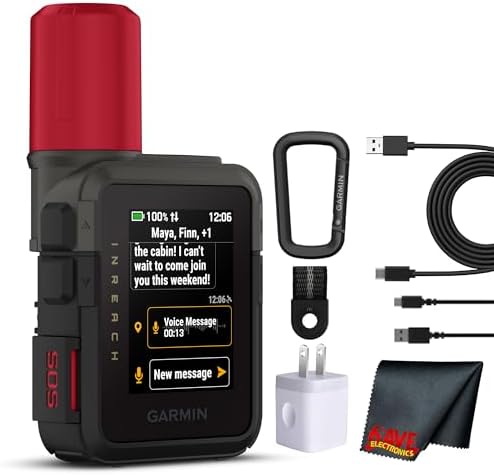
- Bundle Includes: Garmin inReach Mini 3 Plus compact SOS Satellite Communicator + Microfiber Cleaning Cloth + Generic Bra…
- GLOBAL MESSAGING AND MEDIA SHARING: Stay connected outside cell coverage using the Iridium satellite network and exchang…
- INTERACTIVE SOS AND REAL-TIME COORDINATION: Trigger an interactive SOS alert to Garmin Response, a 24/7 staffed emergenc…

- Global Two-Way Messaging: Allows communication with friends and family via text messaging, even in areas without cellula…
- Pairing with Garmin Messenger App: Connects with a compatible smartphone to send messages via satellite or cellular netw…
- Group Messaging and Threaded Conversations: Unlike many satellite communicators, the inReach Messenger supports group me…

- [PROTECTION FOR SATELLITE MESSENGERS]: Hard shell rugged protection securely holds your satellite text communicator devi…
- [PADDED EVA DESIGN]: The interior of our communicator case snugly holds your portable device. Protect your handheld comm…
- [COMPACT AND PORTABLE]: This sleek case measures 5.5″ x 3.75″ x 2.5″ so it can fit in backpacks and bags. It comes with …

- Lightweight SOS satellite communicator uses the global Iridium satellite network so you can stay connected without cell …
- Explore with peace of mind knowing you can trigger an interactive SOS message with location coordinates to Garmin Respon…
- Exchange photos, texts and voice messages without cell service; taking and sending photos requires pairing your inReach …
Frequently Asked Questions
Do I need a satellite messenger for day hikes?
If your day hikes stay inside reliable cell coverage and on popular trails, probably not. The moment you are out of signal, alone, or more than an hour from a trailhead, a messenger changes a bad day into an inconvenience. Many people buy one for a single trip and then keep it because the peace of mind is worth more than the subscription.
Can I use a satellite messenger without a subscription?
No. All three brands require an active plan for messages and SOS to route through their networks. Garmin and ZOLEO both offer month-to-month plans you can suspend between trips, which is the right move if you only travel in summer.
Which one has the best coverage?
Garmin inReach uses Iridium, which is genuinely pole-to-pole. ZOLEO also uses Iridium. SPOT uses Globalstar, which has strong coverage across North America and Europe but gaps in parts of the southern oceans and central Africa. For domestic trips the difference rarely matters; for remote international travel it does.
Does an inReach replace a PLB?
Functionally it overlaps, but a personal locator beacon is a single-purpose device on a government-run rescue network with no subscription. Some people carry both. If you carry one, a two-way messenger is usually more useful because rescuers can ask you questions.
Will it work inside a tent or a pack?
It needs a view of the sky. Messages will often eventually get through from inside a nylon tent, but delivery can take many minutes. Clip it to a shoulder strap facing up while you hike, and set it on open ground when you send.
What happens if I press SOS by accident?
All three let you cancel. The coordination center will message you to confirm before dispatching. Cancel immediately and explain; do not power the device off, because that looks like a failed distress call.

Written by Jake Miller · Camping & Gear
Jake grew up pitching tents before he could drive and has spent 15+ years camping, car-camping, and gear-testing his way across the country. If it can be cooked over a fire or packed into a trunk, he has an opinion on it.