
Heads up: this post contains affiliate links. If you buy through one, we may earn a small commission at no extra cost to you. As an Amazon Associate, we earn from qualifying purchases.
⚡ Quick Answer: To navigate without a compass, use the sun, which rises in the east and sets in the west, or the shadow-stick method to find a north-south line. At night, locate the North Star using the Big Dipper. These natural methods give you a dependable sense of direction when technology fails.
Compasses break, phones die, and sometimes you simply forget one, but the sky and the land have guided travelers for thousands of years. Natural navigation will not replace a map and compass for precise routefinding, yet it can keep you oriented and moving in the right general direction. Here are the most reliable ways to find your way without a compass.
Use the Sun by Day
The sun rises in the general east and sets in the general west, which alone tells you a lot. In the Northern Hemisphere it sits due south at midday, so at noon your shadow points roughly north. Track the sun across the sky and you can hold a steady heading through most of the day without any instrument.
The Shadow-Stick Method
For a more precise line, push a straight stick upright into flat ground and mark the tip of its shadow with a pebble. Wait fifteen to twenty minutes and mark the new shadow tip. A line drawn between the two marks runs roughly east to west, with the first mark toward the west. Stand with the first mark on your left and the second on your right, and you are facing north. It is simple, needs nothing but a stick, and works anywhere sunny.
Find the North Star at Night
On a clear night in the Northern Hemisphere, Polaris the North Star marks true north and barely moves. Find the Big Dipper, follow the two stars at the end of its cup, the pointer stars, straight out about five times their spacing, and you arrive at Polaris. Face it and you face north. If the Dipper is hidden, the W-shaped constellation Cassiopeia sits on the opposite side of Polaris and points back to it.
Read the Landscape
Terrain offers quieter clues. Water flows downhill and streams usually lead toward larger valleys, trails, and eventually people. Prevailing winds often bend trees and shape snowdrifts in a consistent direction for a region. These signs are less exact than the sun or stars, so use them to support your other readings rather than trust them alone.
A Word on Moss and Myths
The old saying that moss always grows on the north side of trees is unreliable, because moss simply favors shade and moisture wherever it finds them. Treat it as a weak hint at best. Lean on the sun and the North Star, which are consistent and trustworthy, and cross-check whenever you can.
Stay Oriented, Stay Safe
Practice these skills on familiar ground so they feel natural under stress. Combine the sun by day and Polaris by night with careful attention to the land, and you can keep a reliable heading even when every gadget you own has failed.
Recommended Gear

- Orienteering Compass with Global Needle & Sighting Mirror – Accurate Navigation Worldwide. Designed with a global needle…
- Adjustable Declination & Built-In Clinometer. Adjust declination to match your geographic location for more accurate map…
- Easy-to-Read in Any Condition – LED Light & Luminous Dial for Day or Night. Built-in LED light illuminates the compass f…

- 【Size Detial】: Each map compass measures 4.17 x 2.48 inches/ 10.6 x 6.3 cm, providing a clear baseplate area for easy ma…
- 【Safety Material 】: This orienteering compass features a durable acrylic body that is lightweight, waterproof, and impac…
- 【Easy to Use】: Designed with a 360° rotating bezel, directional arrows, ruler scale, and a built-in magnifier, this hiki…
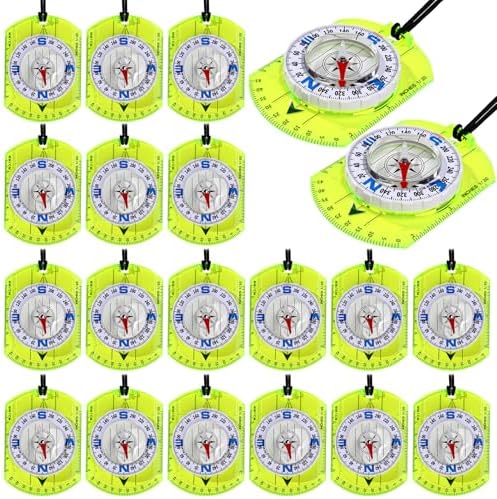
- Compass Set: you can get 20 pieces of yellow orienteering compasses to suit your needs, it is a good companion for your …
- Convenient to Carry: compass hiking survival is about 4.13 x 2.44 inch, compass hiking is small in size and an essential…
- Nice Material: the navigation backpacking compass is mainly made of acrylic, lightweight and reliable, and the compass f…
Frequently Asked Questions
How can you find north without a compass?
By day, the sun rises in the general east and sets in the general west, and at noon your shadow points roughly north in the Northern Hemisphere. The shadow-stick method gives a more precise east-west line. At night, find the North Star using the Big Dipper, and facing it means facing north.
How do you use the stars to navigate?
In the Northern Hemisphere, locate the Big Dipper, follow the two stars at the end of its cup about five times their spacing, and you reach Polaris, the North Star, which marks true north and barely moves. If the Dipper is hidden, the W-shaped Cassiopeia sits opposite Polaris and points back to it.
Does moss really grow on the north side of trees?
Not reliably. Moss simply favors shade and moisture wherever it finds them, so it can grow on any side of a tree depending on local conditions. Treat it as a weak hint at best and rely instead on the sun and the North Star, which are consistent and trustworthy.

Written by Sarah Brooks · Hiking & National Parks
Sarah fell in love with the outdoors on a childhood trip to the Smokies and has logged thousands of trail miles across 30+ national parks since. She is happiest above treeline with a map in hand.