
Heads up: this post contains affiliate links. If you buy through one, we may earn a small commission at no extra cost to you. As an Amazon Associate, we earn from qualifying purchases.
⚡ Quick Answer: What belongs in a wilderness survival kit — the one-pound core of shelter, fire, water, and signaling gear, buy-vs-build advice, and the two rules that make it count.
A survival kit isn’t a bunker in a bag — it’s a pound of gear that turns “unexpected night out” from a life-threatening emergency into a rough story. The best kit is the one that’s actually in your pack, so this list is ruthlessly practical: what earns its weight, what doesn’t, and how to build it around the way you actually get outside.
Build Around the Survival Priorities
Exposure kills in hours, dehydration in days, hunger in weeks — so the kit weights shelter and warmth first, water second, signaling throughout, and food barely at all.
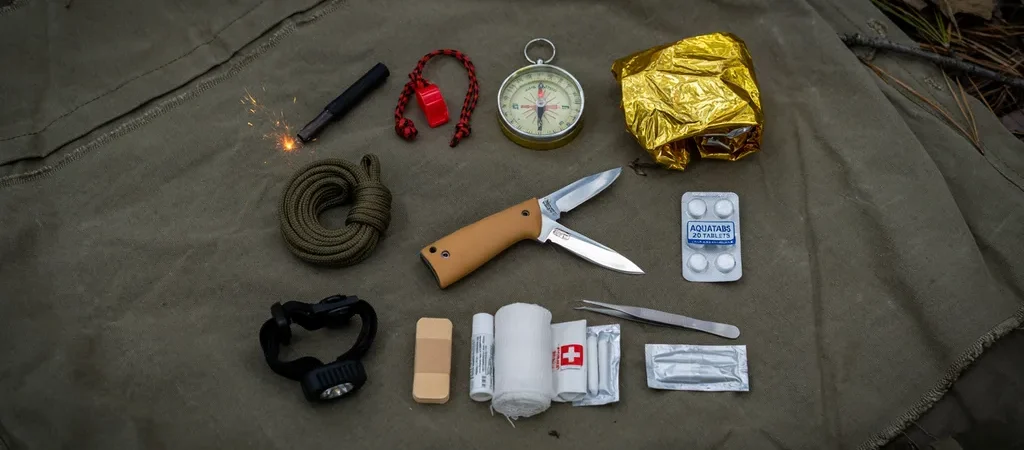
The Core Kit (About One Pound)
- Shelter: an emergency bivy or space blanket — the highest warmth-per-ounce item ever made — plus 25–50 ft of paracord for rigging.
- Fire: a ferro rod AND a lighter AND stormproof matches (redundancy is the point), with a few waxed tinder plugs or petroleum-jelly cotton balls.
- Water: purification tablets and a straw filter; a metal container lets you boil.
- Signaling: a loud whistle (three blasts = SOS) and a small mirror — both work forever, no batteries.
- Navigation: a button compass at minimum; a real baseplate compass if you’ve read our map and compass guide.
- Light: a backup headlamp or keychain light beyond your main one.
- Cutting: a fixed-blade knife is the survival workhorse — batoning kindling, making feather sticks, building shelter.
- Repair & first aid: duct tape wrapped around your bottle, super glue, safety pins, plus the essentials from our first aid kit guide.
- Calories: a couple of high-density bars — morale is a survival resource.
Buy It or Build It?
Pre-made kits are a fine skeleton — good ones include a surprising amount for the price. Just expect to upgrade the knife and add real tinder and a bivy:

- LARGEST STRIKEABLE TINDER: Our largest strikeable tinder ever (strikeable means it’s similar to a match) is windproof an…
- COMPLETE KIT: (1) Behemoth Stormproof Sweetfire Match Kit and (3) Behemoth – Stormproof Tinder Match Fire Starter 3-Pack…
- CLEAN: Made from sugarcane waste – bagasse is a fibrous sugarcane by-product and is used around the world as a renewable…

- ✅【72 Hours for 2 People, STORM II Emergency Survival Kit】STORM II EMERGENCY KIT was designed and hand-picked by survival…
- ✅【Water & Food Approved by U.S. Coast Guard, Water Filtration Tablets】 24 Packs of 125ML Emergency Drinking Water and 2 …
- ✅【First Aid Essential, CAT Tourniquet for Bleeding Control】200 Pieces comprehensive medical supplies and CAT tourniquet …

- High-Quality Sharp Blade: The 6″ 420HC stainless steel clip blade is put through a rigorous heat treat process and perfo…
- Solid Build, Classic Design: First introduced in 1942, the 119 Special carries forward our timeless fixed blade styling….
- Comfortable Grip and Control: The black phenolic handle is crafted with subtle palm swells for a comfortable, secure gri…
Match the Kit to the Trip
- Day hikes: the core kit above, always — day hikers become overnight statistics more often than backpackers.
- Backpacking: your camping gear IS shelter and fire; the kit becomes backups of the critical items, kept on your person, not just in the pack.
- Vehicle kit: scale up — blankets, more water, more food; weight doesn’t matter in a trunk.
- Hunting/remote trips: add a satellite messenger — the single biggest survival upgrade money buys.
The Two Rules That Make It Work
One: the kit lives in your pack permanently — kits assembled per-trip get forgotten. Two: practice with everything once. Strike the ferro rod, deploy the bivy, blow the whistle. Gear you’ve used is equipment; gear you haven’t is luggage. Round out the skills with our guides on emergency shelters, finding water, and getting found when lost.
Frequently Asked Questions
What are the most important items in a survival kit?
Cover the big five: fire (lighter plus backup), shelter (emergency bivvy or tarp), water (filter and purification tablets), signaling (whistle and mirror), and navigation (map and compass). A knife and first aid supplies round out the core.
How big should a wilderness survival kit be?
Small enough that you actually carry it. A kit the size of a water bottle that lives in your pack beats a comprehensive box left in the car. Day hikers can cover the essentials in well under a pound.
Do I really need a survival kit for day hikes?
Yes — most search-and-rescue cases involve day hikers, not expedition backpackers. A twisted ankle three miles from the trailhead can mean an unplanned night out, and a whistle, bivvy, and fire starter turn that from dangerous to merely uncomfortable.
Written by Jake Miller · Camping & Gear
Jake grew up pitching tents before he could drive and has spent 15+ years camping, car-camping, and gear-testing his way across the country. If it can be cooked over a fire or packed into a trunk, he has an opinion on it.