
Heads up: this post contains affiliate links. If you buy through one, we may earn a small commission at no extra cost to you. As an Amazon Associate, we earn from qualifying purchases.
⚡ Quick Answer: How to build an emergency survival shelter — lean-to and debris hut step by step, snow shelters, why insulation below matters most, and the gear that makes it easy.
Exposure — not hunger, not thirst — is what kills people who get stuck out overnight. In wet, windy, or cold conditions, hypothermia can set in within hours, which makes shelter the top priority in almost every survival situation. The good news: a functional emergency shelter is mostly knowledge and effort, not equipment. Here’s how to build one with what the forest gives you.
The Priorities (In Order)
- Location first: out of the wind, off low ground where cold air and water collect, away from dead standing trees (“widowmakers”), and near materials. Two minutes choosing beats an hour rebuilding.
- Small beats big: your body is the furnace — a shelter barely larger than you is the one you can heat.
- Insulation below beats cover above: the ground steals heat faster than the air. A foot-thick mattress of boughs or leaves matters more than a perfect roof.
The Lean-To: Fastest Useful Shelter
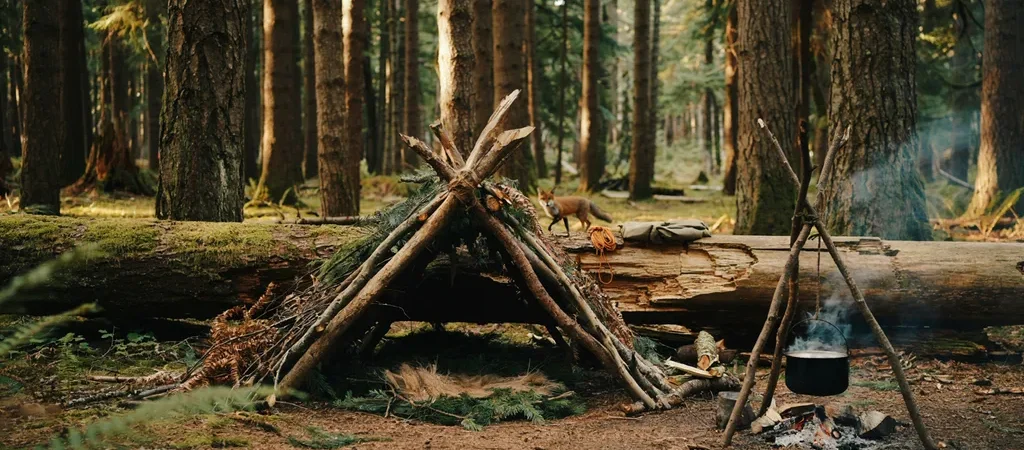
- Find a ridgepole: a sturdy branch wedged between two trees (or against a fallen log/boulder) at hip height.
- Lean branches against it at ~45 degrees on the windward side, packed close.
- Thatch from the bottom up with pine boughs, bark slabs, or leaf litter — bottom-up layering sheds rain like shingles. Aim for a covering thick enough to block all daylight.
- Pile a deep bed of dry debris inside. Compress it — a foot of loose leaves squashes to a few inches of mattress.
- Build a fire in front with a reflector wall of logs behind it, and the lean-to becomes genuinely warm.
The Debris Hut: When It’s Really Cold
Colder and no fire? Build the shelter tighter: a ridgepole from a stump to the ground makes a triangular coffin-shaped frame; rib it with sticks, then bury it in two to three feet of leaves and debris — walls this thick work like a sleeping bag. Stuff the interior with dry leaves and wriggle in feet-first, pulling a plug of debris into the entrance. It’s claustrophobic and it works.
Snow Country Notes
Snow is an excellent insulator: a tree well (the natural hollow under a big conifer) roofed with boughs, or a trench cut into a drift and covered, both beat open air by twenty degrees. Never let clothing get sweat-soaked while digging — strip layers, work slow, stay dry.
Carry the Cheat Codes
A few ounces of gear turns an hour of shelter-building into minutes: an emergency bivy reflects your body heat back, and a tarp with paracord makes a weatherproof roof instantly (see our tarp shelter guide):

- 【FOUR Emergency Bivy Sack】4 pack portable emergency sleeping bag were included, ready for your next adventure. Survival …
- 【Ideal Size】Emergency bivy sleeping bag reflects back 90% of body heat. Wearing emergency sleeping bags for survival pre…
- 【Portable Design】Each pack weight only 4.5 oz (with the carry bag). Each pack is 4.7 inches by 2.7 inches by 1.7 inches….

- Mylar, Reflective, Bivy Sack, Bivvy Sack
- Imported
- Losing body heat is a major cause of death in emergency. The Leberna Emergency Survival Mylar Thermal Sleeping Bag can i…

- PATENTED MILITARY GRADE DURABILITY – SurvivorCord is not cheap and for good reason. It is the original patented paracord…
- MULTI-PURPOSE & VERSATILE – Whether you’re using it for securing gear, as a parachute cord, creating shelters, or emerge…
- 3 INTEGRATED SURVIVAL STRANDS – Our survival paracord includes three life-saving strands: a clear and transparent 25-LB …
Practice Before You Need It
Build one in the backyard or on a casual camping trip — the skills are genuinely fun to practice and completely different at 5 pm with wet hands than in a YouTube video. Pair this with reliable fire starting, water skills, and knowing what to do when lost — that’s the survival core, right there.
Frequently Asked Questions
What is the fastest emergency shelter to build?
A debris lean-to against a fallen log or rock face: ridge support, angled wall of branches, then a thick thatch of leaves and boughs. In snow, a tree well or trench shelter is faster than any snow cave. Practice before you need it.
How do you stay warm in an emergency shelter overnight?
Insulation below beats insulation above: pile 8-plus inches of dry debris as a mattress, make the shelter barely bigger than your body, block the entrance, and if safe, place a small fire with a reflector wall outside the opening.
When should you stop and build shelter instead of hiking out?
When darkness, injury, or weather makes travel more dangerous than staying — a rule that should trigger about two hours before you think it does. A night in a rough shelter is survivable; a night walk off a ledge is not.
Written by Jake Miller · Camping & Gear
Jake grew up pitching tents before he could drive and has spent 15+ years camping, car-camping, and gear-testing his way across the country. If it can be cooked over a fire or packed into a trunk, he has an opinion on it.