
Heads up: this post contains affiliate links. If you buy through one, we may earn a small commission at no extra cost to you. As an Amazon Associate, we earn from qualifying purchases.
⚡ Quick Answer: Buy a flasher first. Its real-time display shows your jig and the fish reacting to it with no lag, which is the single biggest skill jump available to a new ice angler. Add an underwater camera later for identifying species and reading structure, and treat GPS mapping as a separate purchase.
Ice fishing is the one form of fishing where electronics change your behavior in real time. In open water, sonar tells you where to cast. Through the ice, sonar shows you your own lure, the fish swimming toward it, and whether that fish liked what you just did with your wrist. You are watching cause and effect on a two-second delay.
That feedback loop is why a flasher teaches faster than any article can, including this one. Here is what the categories actually do and the order to buy them in. For the rest of the kit, see our complete ice fishing gear guide.
Flashers: the real-time option
A flasher displays returns as colored bars around a circular dial. Bottom is a thick band at your depth. Your jig is a thin line above it. A fish is a separate mark that rises, falls, and merges with your jig when it commits.
The critical property is that a flasher has effectively no lag. When you lift your rod, the jig mark moves at the same instant. When a fish rises three feet to look and then drops, you see the whole event and you know your last move was almost right. Nothing else in fishing gives you that.
Reading one takes about twenty minutes of practice. Set the gain, which is sensitivity, just high enough that you can see your jig clearly without the whole dial filling with noise. Then set the depth range to slightly more than the water you are in, because a range set to two hundred feet in fifteen feet of water compresses everything into an unreadable smear.
LCD graphs: the history option
A graph scrolls a picture of the last several seconds across the screen. That history is genuinely useful for reading bottom hardness, seeing weed lines, and confirming a pattern of fish moving through, and modern units run flasher-style displays alongside the scrolling view.
The trade-off is the refresh delay. On cheaper units the lag between your rod movement and the screen is enough to break the feedback loop that makes a flasher so instructive. If you already own a summer fish finder with an ice transducer available, that is a fine place to start. If you are buying specifically for ice, start with a flasher.
Cone angle, and why your screen is cluttered
Sonar radiates in a cone. Cone angle determines how wide an area you are seeing.
- Narrow, eight to twelve degrees. Best default. Focused directly below the hole, minimal clutter from nearby structure, works well in deep water.
- Wide, nineteen to twenty degrees. Sees more water, which helps in shallow depths where a narrow cone covers almost nothing. Also shows fish approaching from the side before they are under you.
In twelve feet of water, a twenty-degree cone covers a circle roughly four feet across. In fifty feet, it covers about seventeen feet, which means you will see fish you cannot possibly reach and will misread them as ignoring your bait.
Underwater cameras
A camera answers questions sonar cannot: what species is that, is it a keeper, is that mark on the bottom a rock or a stump, is my bait presented naturally. In clear water it is the difference between guessing and knowing.
Its limits are real, though. Stained water reduces visibility to inches. Deep water gets dark, and camera lights sometimes spook fish. The cable also twists, so the camera slowly rotates unless you use a fin attachment. Treat it as a learning and scouting tool rather than a replacement for sonar. It pairs particularly well with the structure-reading approach in our guide to finding fish under the ice.
GPS and mapping
Mapping is a separate need from sonar, and combining them into one unit costs considerably more. What GPS buys you on ice is the ability to return to the exact spot that produced last week and to follow a contour line while drilling, rather than guessing where the break is under two feet of snow.
If your budget is limited, a phone app with downloaded offline lake charts covers most of this for a fraction of the price. Keep the phone warm and charged; battery drain in the cold is severe.
Batteries and the cold
Every runtime figure on the box was measured at room temperature. Plan on about half of it near zero degrees.
Lithium batteries lose far less capacity in cold than sealed lead-acid and weigh a fraction as much, which matters when you are dragging a sled. Charge fully the night before, keep the battery in an insulated compartment, and never store a lead-acid battery discharged over winter or it will not come back.
What to buy first
- Season one: a flasher. Even an entry-level unit transforms how much you understand about what is happening below you.
- Season two: a camera if you fish clear water, or GPS mapping if you fish large lakes and struggle to relocate spots.
- Later: a combo unit when you know which features you actually use.
Whatever you carry out there, check the ice first. Our ice thickness and safety guide covers the thresholds that matter, and a shelter will keep both you and your electronics working longer.
Recommended Gear

- The power of simple – offers a keyed interface with dedicated buttons. The Device is easy to use and easy to install. Av…
- Waypoint map – use the waypoint map to easily view, Mark and navigate to locations such as brush piles, stumps and docks
- Chirp sonar – Chirp sends a continuous sweep of frequencies which provides a wider range of information. Chirp sonar is …
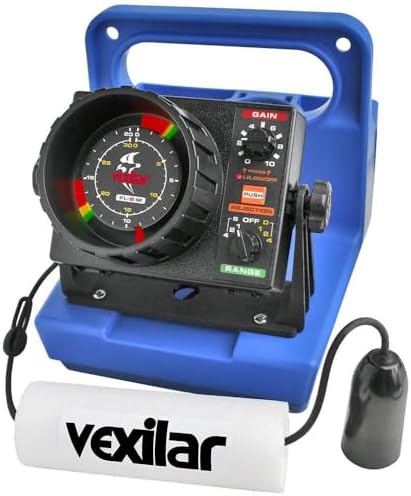
- Vexilar FL-8SE GENZ Pack w/19 Ice Ducer [GP0819]

- This unit has a Special low power mode option that allows you to fish in extremely shallow water with great target resol…
- Five depth ranges to 120 feet
- It offers a unique night mode option so the display is easier to view
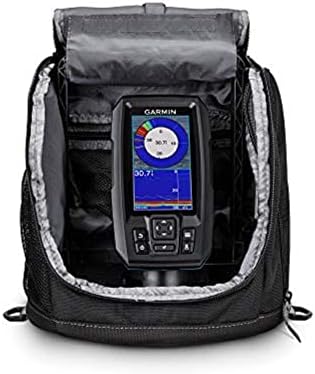
- Easy-to-use 4” color fishfinder with built-in, high-sensitivity GPS
- Includes dual-beam ice fishing transducer with Garmin CHIRP traditional sonar for crystal-clear images and remarkable ta…
- Includes built-in Quickdraw Contours mapping
Frequently Asked Questions
Do I really need a flasher to ice fish?
No, but nothing else improves your catch rate as fast. A flasher shows your jig, the bottom, and fish approaching in real time, so you learn what triggers a bite and what spooks fish within a single trip instead of over several seasons.
What is the difference between a flasher and a graph?
A flasher shows what is under you right now as bars on a circular dial, with essentially no delay. A graph, or LCD sonar, scrolls a history of the last several seconds from right to left. The flasher is better for watching a fish react to your jig; the graph is better for seeing a trend and reading bottom composition.
What cone angle should I use for ice fishing?
A narrow cone, around eight to twelve degrees, for most situations. It keeps the signal focused in the small area around your hole and reduces clutter. Wider cones of nineteen to twenty degrees show more water and are useful in shallow depths where a narrow cone sees almost nothing.
Are underwater cameras worth it for ice fishing?
They are excellent for learning and for identifying what is down there, especially in clear water where you can see whether the fish following your jig is a keeper walleye or a small perch. They are less useful in stained water and in deep water where light does not reach.
How long do ice fishing electronics batteries last in the cold?
Expect roughly half of the rated runtime at temperatures near zero. Lithium batteries hold up far better than sealed lead-acid, and keeping the battery inside an insulated case or in your shelter makes a large difference.

Written by Jake Miller · Camping & Gear
Jake grew up pitching tents before he could drive and has spent 15+ years camping, car-camping, and gear-testing his way across the country. If it can be cooked over a fire or packed into a trunk, he has an opinion on it.