
Heads up: this post contains affiliate links. If you buy through one, we may earn a small commission at no extra cost to you. As an Amazon Associate, we earn from qualifying purchases.
⚡ Quick Answer: A hub shelter is the best first buy for most anglers: maximum room per dollar, packs into a duffel, and fits family or friends. Flip-overs win for solo run-and-gun fishing — shelter and sled in one. Size up one person beyond the rating, anchor every corner, and never run a heater without ventilation.
Wind is what ends ice fishing days — not cold. Ten degrees and calm is pleasant; twenty-five degrees with a northwest wind is a countdown timer. A shelter turns hard-water fishing from an endurance event into something a family volunteers for twice, and today’s options are lighter, warmer, and cheaper than the sport has ever seen.
New to hard water? Start with ice fishing for beginners and our ice thickness safety guide, then come back to pick your shelter.
Hub Shelters: The Most Room for the Money
A hub shelter is a pop-up: push the walls out, pop the roof, and a six-sided fabric room appears on the ice. For the price of a decent rod-and-reel setup you get space for three or four anglers, standing headroom in the center, and a package that stows in a shoulder duffel. This is the shelter for anyone who fishes with kids, friends, or a heater and a card game.
The trade-off is deployment time and wind. A hub takes a few minutes to set up and anchor, and it is not a shelter you move every twenty minutes — you pick a spot, drill several holes inside and around it, and commit for a stretch. In wind, anchors are not optional: an unanchored hub on glare ice is a very expensive kite, and every ice belt town has a story about one skating across the lake.
Flip-Over Shelters: Mobility With a Roof
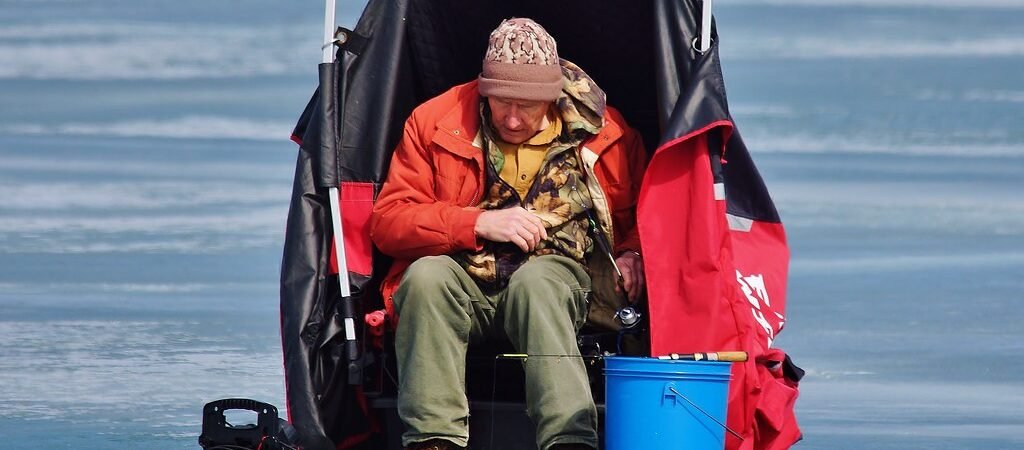
A flip-over is a sled with a seat and a folding canopy — tow it to a spot, flip the roof over your head, and you are fishing in thirty seconds. When the spot dies, flip it back and pull to the next hole. For the solo or two-angler crowd chasing walleye and perch with a hole-hopping strategy, this is the tool the tactic was named for.
The cost is weight and bulk: flip-overs ride in a truck bed rather than a trunk, and pulling one by hand across slush is honest exercise. If your winters involve a snowmobile or ATV, the weight stops mattering and the mobility becomes everything.
Sizing: The One-Person Rule
Whatever the tag says, subtract one. A ‘3-person’ hub holds two anglers, their buckets, a heater, and the gear explosion that ice fishing generates; a ‘6-person’ hub is a comfortable four. Rod length matters too — jigging inside a low shelter with a 36-inch rod teaches geometry fast.
Heat, Light, and the Rule That Keeps You Alive
A small portable propane heater turns a shelter into a t-shirt environment even in single digits — it is the upgrade that converts skeptical family members permanently. But heaters consume oxygen and produce carbon monoxide, so the rule is absolute: crack two vents, always, no matter how cold it is outside. Modern shelter heaters have low-oxygen shutoffs and tip-over switches; use one of those, keep it clear of walls, and never sleep with it running.
Do You Even Need One?
On mild, calm days — no. Plenty of anglers fish all season from a bucket in the open and love it. Buy the shelter when wind, kids, or ambition for full-day trips enter the picture. If that is your first winter, spend on the core gear and a good auger first, and let one miserable windy afternoon make the shelter decision for you.
Recommended Gear

- Triple-Layer Insulated Protection: This ice fishing tent is crafted from durable 210D oxford fabric with 100g acupunctur…
- Effortless Pop-Up Design: Experience hassle-free setup and takedown with this portable ice fishing shelter. The convenie…
- Reinforced Stability & Strength: The ice shanty features a sturdy metal ball-and-socket frame with 11 mm fiberglass rods…

- NO-TRIP DOOR – Full panel door zips open from ice level, leaving nothing to catch a boot on or duck under when entering …
- PACKDOWN HUBS – Optimized hub location and pole geometry condenses the pack down length of the shelter to just 58”, so i…
- STORMSHIELD INSULATED FABRIC – Three-layer bonded fabric with 80 grams of high-loft insulation create a robust barrier a…

- 2-3 people with 48 fishable Sq. Ft.
- 5 sides and weighs 36 lbs. – 75” Ceiling Height / 67” Wall Height
- Full door with dual coiled zippers
Frequently Asked Questions
What is the difference between a hub and flip-over ice shelter?
A hub is a pop-up fabric room — the most space per dollar, ideal for groups, but slower to set up and meant to stay put. A flip-over is a sled with a fold-over canopy — thirty seconds to deploy and built for constantly moving between holes, but heavier and bulkier to transport.
Can you use a heater in an ice fishing shelter?
Yes — a portable propane heater with a low-oxygen shutoff is standard equipment — but ventilation is non-negotiable. Always open two vents to keep fresh air moving, keep the heater clear of fabric walls, and never sleep with it running. Carbon monoxide, not cold, is the real danger inside shelters.
What size ice shelter do I need?
Subtract one from the rating: a ‘3-person’ shelter fits two anglers plus gear comfortably, a ‘6-person’ fits four. Ice fishing involves buckets, heaters, augers, and tackle — the rating assumes people standing still with none of it. When between sizes, go bigger; heat loss difference is minor.
Written by Jake Miller · Camping & Gear
Jake grew up pitching tents before he could drive and has spent 15+ years camping, car-camping, and gear-testing his way across the country. If it can be cooked over a fire or packed into a trunk, he has an opinion on it.