
Heads up: this post contains affiliate links. If you buy through one, we may earn a small commission at no extra cost to you. As an Amazon Associate, we earn from qualifying purchases.
⚡ Quick Answer: The best spotting scopes for hunting, birding, and wildlife watching — magnification numbers decoded, angled vs. straight, and top picks from budget to premium.
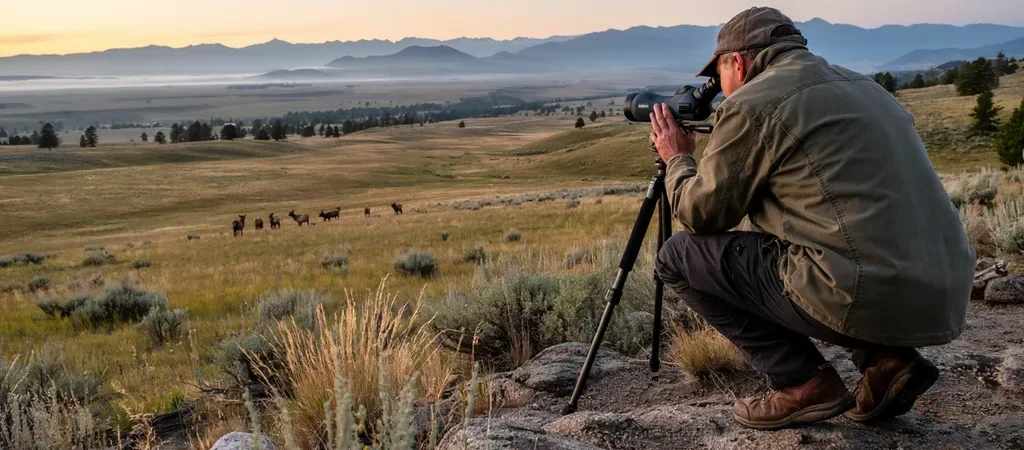
Binoculars show you that something is on the far ridge; a spotting scope tells you what it is. For hunters counting tines, birders identifying shorebirds at distance, and anyone who wants a closer look at wildlife without getting closer, a spotting scope is the tool binoculars can’t replace. Here’s how to choose one without overspending.
Spotting Scope vs. Binoculars
Binoculars (8–10x) are for finding; scopes (20–60x) are for confirming. A scope’s magnification reveals detail at half a mile that no binocular can, but it needs a tripod, takes time to set up, and has a narrow field of view. Most serious glassers carry both: binoculars to scan, scope to judge. If you’re choosing your first optic, start with our binoculars guide — a scope is the upgrade, not the entry point.
Decoding the Numbers
- 20–60×80 means: zoom from 20x to 60x magnification through an 80mm objective lens. Bigger objective = brighter image, especially at dawn and dusk.
- Angled vs. straight: angled eyepieces are more comfortable for long sessions and sharing between heights; straight is faster to point and easier from a vehicle window.
- Glass quality beats max power: a sharp image at 40x beats a mushy one at 60x. Atmospheric shimmer usually limits useful power anyway.
- The tripod is half the system: a wobbly tripod makes a great scope useless. Budget for a solid one.
Top Spotting Scopes
Leupold’s Alpine HD punches far above its price on glass quality, while the Gosky 20-60×80 is the proven budget pick that gets people into the game:

- Model #185684 – SX-4 Pro Guide HD Gen 2 20-60x80mm Spotting Scope – Angled Eyepiece

- 20-60X Continuous Zoom: Whether you’re scanning the horizon or zooming in on fine details, simply turn the zoom ring for…
- 80mm Objective Lens + Fully Multi-Coated Optics: Low light at dawn or dusk? No problem. The large 80mm lens gathers more…
- Dual Focus System: Coarse focus locks onto your target fast, while fine focus dials in the perfect sharpness. Whether yo…

- [20-60X Variable Zoom & Precise Focus] Our spotting scope features smooth variable magnification from 20x to 60x with a …
- [80mm FMC Green Film Objective & BAK4 Prism] This spotting scope’s 80mm fully multi-coated green film objective lens del…
- [45° Angled Eyepiece & Rugged Build] This high power spotting scope features a 45-degree angled eyepiece to reduce neck …
Who Needs Which
- Western hunters: this is core equipment — judging animals across canyons saves miles of boot leather. Pair with a solid tripod.
- Birders: an angled 20-60x scope opens up waterfowl, shorebirds, and raptor nests that binoculars just hint at.
- Target shooters: spotting hits at 200+ yards without walking downrange.
- Casual wildlife watchers: be honest — a good 10×42 binocular may serve you better for the money.
Field Tips
- Start at lowest power to find your subject, then zoom in.
- Brace the tripod low in wind; height adds wobble.
- Early and late light beats midday shimmer for judging detail at distance.
- Use your phone camera through the eyepiece (digiscoping) to record what you find.
For more glassing destinations, see our guides to the best birding hotspots and wildlife watching basics.
Frequently Asked Questions
What is a spotting scope used for?
A spotting scope is a compact, high-power telescope for viewing distant objects on land, used for wildlife watching, hunting, birding, and target shooting. It offers far more magnification than binoculars, letting you study detail at long range, and it is typically mounted on a tripod for stability.
Spotting scope or binoculars, which do I need?
Binoculars are lighter, faster to use, and better for scanning and shorter distances, while a spotting scope provides much higher magnification for studying distant detail. Many enthusiasts carry binoculars for general use and add a spotting scope when they need serious reach on a tripod.
What magnification do I need in a spotting scope?
Most spotting scopes offer a zoom range such as 20 to 60 power. Around 20 to 40 power is useful and steady for most viewing, while the highest magnifications show more detail but a dimmer, shakier image affected by heat haze. Quality glass and a solid tripod matter as much as raw power.

Written by Tom Rivera · Fishing & Hunting
Tom has spent four decades outdoors — on lakes, rivers, and treestands — and still fishes most weekends. These days his favorite catch is watching his grandkids reel in their first bluegill.