
Heads up: this post contains affiliate links. If you buy through one, we may earn a small commission at no extra cost to you. As an Amazon Associate, we earn from qualifying purchases.
⚡ Quick Answer: Fish a 1/32 to 1/64 ounce tungsten jig on a 26-inch ultralight rod with 2 to 3 pound line. Find crappie suspended over the deepest basin, bluegill near remaining green weeds, and perch tight to the bottom on flats. When a fish follows without eating, stop moving the jig and hold it dead still.
Panfish are the right first target through the ice, and not as a consolation prize. They are abundant, they are found in nearly every lake, they bite through the entire season including the dead weeks of midwinter, and they are excellent to eat. They also teach technique, because a bluegill will refuse a badly presented jig in a way a hungry pike never will.
This covers crappie, bluegill, and yellow perch, which behave differently enough that lumping them together costs you fish. If you are new to the season entirely, start with our ice fishing for beginners guide first.
Where each species actually is
This is most of the game. Panfish in winter are not spread evenly, they are stacked in specific places, and once you find one you have usually found forty.
- Crappie: suspended, over the basin. They hover well off bottom over the deepest water available, frequently in the middle third of the water column. Twenty feet down over a forty-foot bottom is a completely normal reading.
- Bluegill: near cover, close to bottom. Look for the last remaining green weeds, brush piles, and inside turns on weed edges in eight to eighteen feet.
- Yellow perch: on the bottom, on flats. Perch nose around the bottom in schools hunting invertebrates. Sandy or gravel flats adjacent to deeper water are the classic spot, and they roam, so if a hole dies they moved rather than stopped feeding.
The season shifts these. Early ice keeps fish shallower and closer to weeds. Midwinter pushes everything deeper and slower. Late ice brings fish back shallow toward spawning areas and produces some of the best panfish action of the year. Our guide to finding fish under the ice covers the structure reading in more detail.
Tackle that matches the fish
Panfish gear is genuinely specialized, and using walleye equipment costs you most of your bites because you never feel them.
- Rod: 24 to 28 inches, ultralight, with a soft tip that loads under the weight of the jig alone. If you cannot see the tip bend when your jig hangs from it, the rod is too stiff.
- Line: 2 to 3 pound monofilament, fresh. Old coiled line hides light bites completely.
- Reel: a small spinning reel is fine. An inline reel is better because it stops the jig from spinning slowly on the drop, which matters when fish are picky.
Our ice rod and reel guide goes deeper on length, power, and the inline versus spinning decision.
Jigs: size, weight, and color
Tungsten is worth the extra money for panfish. It is roughly twice as dense as lead, so a tungsten jig gets down fast while keeping a tiny profile, and it transmits what is happening better. A 1/32 ounce tungsten jig is about the size of a 1/64 ounce lead one.
Start at 1/32 ounce. Go down to 1/64 or smaller when fish rise, look, and leave. Go up to 1/16 when you are fishing deep, fighting wind, or the fish are aggressive and you want to get back down quickly.
Color matters less than most tackle displays suggest, but two rules hold. In clear water and bright conditions, natural and subtle colors outfish bright ones. In stained water, low light, or under snow cover, glow and chartreuse get found. Recharge glow paint with a camera flash or a headlamp every few drops.
For the mechanics of working a jig, our jig fishing basics guide applies directly here.
Bait and plastics
Waxworms and spikes are the traditional choice and they work. Thread one so the hook point stays exposed, and replace it as soon as it stops leaking scent, which happens faster than you think.
Small soft plastics have largely caught up and have practical advantages: they last dozens of fish, they do not freeze into a solid block, and they let you fish faster because you are not rebaiting. Many anglers now run plastics while hole-hopping and switch to live bait only when fish get difficult.
The presentation that catches the fish you are losing
Beginners jig too much. It is the most common and most costly error in panfish fishing.
The sequence that works: drop to the depth fish are holding, then use a fast, aggressive shake to call them in from a distance. Watch your sonar. The moment a mark separates from the school and starts rising toward your jig, stop. Hold the jig dead still, or lift it a half inch at a time so slowly it looks accidental. That pause is what converts a looker into a bite.
If a fish rises and then settles back down, you moved too much. If fish never come at all, either you are in the wrong place or the jig is too big. Give a hole ten minutes, then drill another. Hole-hopping is how good panfish anglers work, and it is why a sharp auger pays for itself.
Species notes worth knowing
Crappie feed hardest in the last hour of light and often keep going after dark. They have soft, papery mouths, so set the hook with a lift rather than a snap, and do not horse them.
Bluegill are the fussiest of the three and reward the smallest jigs and the stillest presentation. They also tend to bite steadily through the middle of the day, when crappie go quiet.
Perch travel in schools and compete, so when a school arrives you can catch several quickly. That competition means a slightly larger and more aggressive presentation often works better for perch than for the other two.
Dress for a day of standing on open ice, since panfish often means moving between holes rather than sitting in a shelter, and check thickness as you go using our ice safety guide.
Recommended Gear
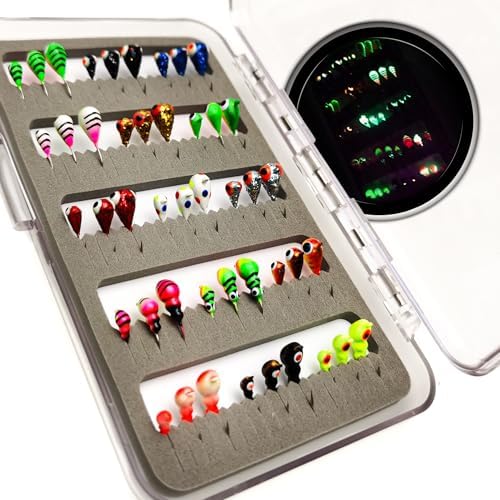
- 【45 PCS UV Glow Tungsten Ice Fishing Jigs Kit for Any Angler】45 pcs UV GLOW PAINT TUNGSTEN with 2 style Teardrop and Lar…
- 【Sharp and Durable Tungsten Ice Fishing Jigs】VMSIXVM Glow tungsten ice fishing jigs are 1.7 times denser than other mate…
- 【Widely Fishing Targets】VMSIXVM tungsten fishing lures feature proven fly hook patterns to match natural food sources, m…

- 【High-Quality Material】 The Pezlun Ice Fishing Jigs Kit is crafted from durable lead jigs, featuring a bright painting a…
- 【Glow in the Dark Design】 Our ice fishing jigs glow in the dark, making them irresistible to fish during nighttime or lo…
- 【Versatile Applicability】This Ice Fishing Jigs Kit is perfect for use in both saltwater and freshwater environments acro…

- Pre-Rigged for Instant Fishing: Start fishing immediately with ice fishing jigs that come pre-rigged with two tungsten j…
- Tungsten Jig Heads for Faster Drop: Rigged on tungsten jig heads in 1/28 and 1/16 oz sizes, these lures sink faster than…
- Realistic Micro Fry Design: The long shank and 90-degree angle on these tungsten flat fry jigs allow for a more horizont…

- 【Two Tackle Boxes Included】 This ice fishing jig set comes with 100 hooks organized in two versatile boxes that can be s…
- 【Efficient Ice Fishing Jigs Set】 The 100-piece set includes 20 different highly realistic jig designs. Their lifelike sw…
- 【Wide Range of Target Species】 These jigs are extremely effective at attracting game fish both under ice and in open wat…
Frequently Asked Questions
What size jig is best for panfish through the ice?
One thirty-second to one sixty-fourth of an ounce for most situations, in tungsten so it sinks fast despite the tiny profile. Go smaller when fish are inspecting and refusing, larger when you need to reach depth quickly or fish are aggressive.
Where do crappie go in winter?
Crappie suspend, often well off the bottom over the deepest basin in the lake. They may sit in twenty feet of water over a forty-foot bottom. This is why they are so much easier to find with sonar than by guessing.
What is the best bait for ice fishing panfish?
Waxworms and spikes, which are fly larvae, are the standards and both stay alive in the cold. Small soft plastics work nearly as well, last far longer, and save you from digging through a container with numb fingers.
Why do panfish follow my jig without biting?
Usually because the jig is moving too much. Panfish inspect closely in cold water. When a fish rises to your jig on the sonar, stop jigging and hold the lure perfectly still, or lift it a few inches very slowly. Deadsticking triggers far more of these fish than more aggressive action.
What time of day is best for ice fishing panfish?
The first and last ninety minutes of daylight are strongest, particularly for crappie, which feed heavily at dusk. Perch are more reliably a midday fish, which makes the two species complementary on a full-day trip.

Written by Jake Miller · Camping & Gear
Jake grew up pitching tents before he could drive and has spent 15+ years camping, car-camping, and gear-testing his way across the country. If it can be cooked over a fire or packed into a trunk, he has an opinion on it.