Heads up: this post contains affiliate links. If you buy through one, we may earn a small commission at no extra cost to you. As an Amazon Associate, we earn from qualifying purchases.
What the law actually says. The U.S. Coast Guard requires a recreational vessel — a kayak or canoe included — to carry one Coast Guard–approved wearable life jacket for every person aboard. Carrying it is the federal requirement for adults; wearing it is not. The exception is children: federal law requires that when a vessel is underway, children under 13 must wear a Coast Guard–approved life jacket, unless they are below deck or in an enclosed cabin. State rules go further in many places and child age limits vary, so check your state boating agency before you launch.
⚡ Quick Answer: To learn paddleboarding: start kneeling on a wide (32″+) board in calm water, stand up in one smooth motion with feet where your knees were, keep a slight bend in the knees, and look at the horizon — not your feet. Wear the leash and a PFD, start on windless mornings, and expect to be comfortably cruising within your first hour.
Stand-up paddleboarding is the friendliest learning curve on the water: most people go from wobbly to cruising in a single calm morning, and the workout sneaks up on you (core, legs, balance — it’s all happening). Here’s how to have a great first session, and what to know before buying a board.
Your First Hour, Step by Step
- Conditions decide everything: pick a windless morning on a calm lake or slow bay. Wind is the beginner’s only real enemy.
- Start kneeling: paddle around on your knees to feel the board’s stability. There is no rush to stand.
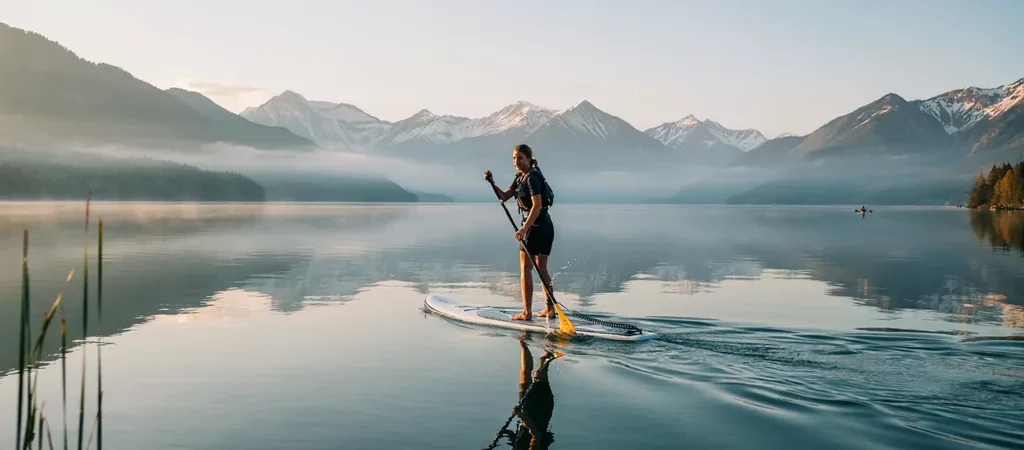
- The stand-up: set the paddle across the deck, hands on the rails, one foot at a time to where your knees were (just behind the handle), then rise in one motion looking FORWARD.
- Stay standing: feet hip-width, knees soft, eyes on the horizon. Staring at your feet is the universal cause of the first swim.
- Falling is fine: fall away from the board (flat water, soft landing), climb back on from the center. Everyone swims on day one; it stops mattering immediately.
Paddle Technique (The 20% That Matters)
- Blade angle faces AWAY from you (it looks backwards; it’s right).
- Reach forward, plant the blade fully, pull to your feet — power from the core rotation, not the arms.
- Switch sides every few strokes; stacked hands (top hand over bottom) keep the board tracking straight.
- Turning: sweep a wide arc away from the nose, or drag-turn from the tail once confident.
Safety Basics
- Leash always — the board is your flotation, and wind moves a loose board faster than you can swim.
- PFD: legally required on most waters (boards count as vessels); belt-pack inflatables keep it comfortable.
- Wind check before launch: offshore breeze means a brutal paddle home — start INTO whatever wind exists.
- Cold water = dress for immersion, not air (the hypothermia rules apply on paddleboards more than anywhere).
Renting vs. Buying
Rent for the first few sessions. When you buy: beginners want 10’6″–11′ length and 32–34″ width (stability), and inflatables win for most people — car-trunk portable, closet-storable, and tougher than they sound. Complete kits include pump, paddle, and leash:

- 【Wider & Stronger for Enhanced Stability】 Built with an ultra-wide 34” deck and 6” thick structure, this 11′ inflatable …
- 【Premium Non-Slip EVA Deck & Durability】 Constructed from military-grade PVC, this board resists punctures and UV damage…
- 【Full Travel Kit with Paddle Board Essentials】 Each SUP set comes with an adjustable paddle, air pump, 3 removable fins,…

- 1. All-Skill Friendly & Stable Build At 9’9″ long with an ultra-wide 30.5″ deck, this inflatable SUP board delivers supe…
- 2. Durable High-Pressure Construction Crafted with a high-density drop-stitch inner core and a tough PVC outer layer, th…
- 3. User-Centered Functional Details It comes with practical design features: elastic bungee cords to secure personal bel…
Where to take it: glassy mornings on the best paddling lakes, and — once your balance is dialed — SUP fishing and SUP yoga await down the rabbit hole. Flat water, morning light, coffee on the shore after: it’s a lifestyle for a reason.
Frequently Asked Questions
Is paddleboarding hard for beginners?
Stand-up paddleboarding is easy to learn, and most beginners are standing and paddling within their first session on calm water. Start on flat, calm water, begin on your knees to find your balance, then stand with feet hip-width apart. Falling in is part of learning, so start where it is safe.
What do you need to start paddleboarding?
You need a paddleboard, a paddle sized to your height, a personal flotation device, and a leash that keeps you attached to the board. Inflatable boards are popular for being portable and stable. Dress for the water temperature, and start on calm, protected water.
How do you stay balanced on a paddleboard?
Keep your feet parallel and hip-width apart centered on the board, bend your knees slightly, look at the horizon rather than down, and use the paddle for stability. A wider, longer board is more stable for beginners. Balance comes quickly with a little practice on calm water.

Written by Sarah Brooks · Hiking & National Parks
Sarah fell in love with the outdoors on a childhood trip to the Smokies and has logged thousands of trail miles across 30+ national parks since. She is happiest above treeline with a map in hand.