
Heads up: this post contains affiliate links. If you buy through one, we may earn a small commission at no extra cost to you. As an Amazon Associate, we earn from qualifying purchases.
⚡ Quick Answer: Better outdoor photos come from timing and light, not gear: shoot golden hour (the hour after sunrise/before sunset), put something in the foreground for depth, use the rule of thirds, and get low or close more often. Your phone is genuinely enough — protect it, shoot RAW if it offers, and edit with a light touch.
The mountains looked enormous; the photo looks like a parking-lot postcard. Every outdoor photographer starts there. The fix is rarely a better camera — it’s light, composition, and a handful of habits that turn snapshots into images you’ll print. Here’s the field guide.
Light Is Everything
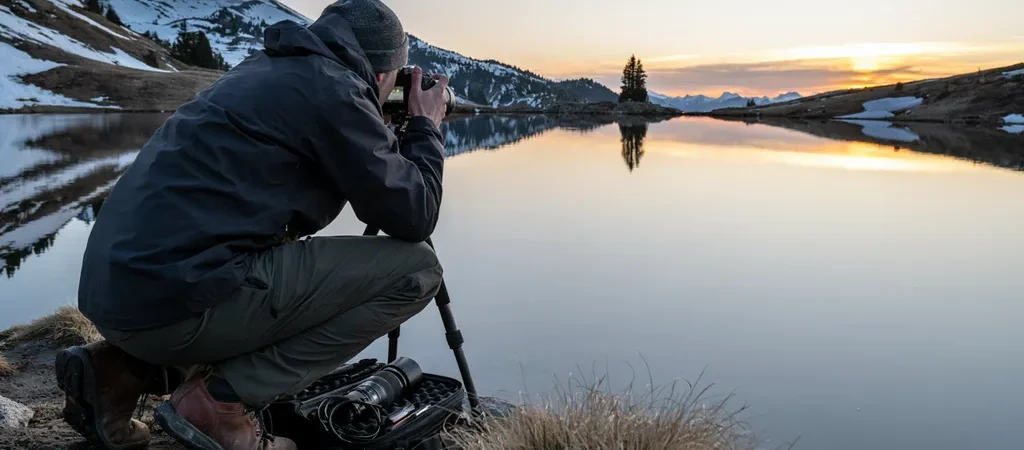
- Golden hour (the hour after sunrise and before sunset) makes everything better — warm, soft, directional. Plan hikes so the payoff view lands in it.
- Blue hour (just after sunset) is the secret for lakes and skylines — calm water, glowing sky.
- Midday sun is the enemy — harsh shadows, squinting people, flat landscapes. If you must, find shade for people and use harsh light for bold shadow patterns.
- Overcast is portrait weather: clouds are a giant softbox — waterfalls, forests, and faces all improve.
Composition Habits That Stick
- Rule of thirds: put the horizon on the top or bottom third (never the middle), subjects at the intersections. Turn on your camera grid.
- Foreground, midground, background: flowers or rocks up front give mountains scale and depth — the single biggest landscape upgrade.
- Leading lines: trails, rivers, ridgelines, and shorelines that pull the eye into the frame.
- A human for scale: a small figure in a big landscape (red jacket helps) tells the size story mountains can’t tell alone.
- Change your altitude: crouch low, climb the boulder — eye-level is the view everyone already has.
Phone Camera, Full Power
- Clean the lens (pocket lint ruins more shots than any setting), tap to focus, and drag exposure down slightly for richer skies.
- Shoot RAW/ProRAW if offered — massive editing headroom.
- Burst mode for wildlife and kids; night mode braced on a rock for camp scenes.
- Edit lightly: a small crop, gentle contrast, slight warmth. The heavy-filter years are over.
Wildlife and Ethics
Long lens or no photo — approaching wildlife for a picture stresses animals and gets people hurt (our wildlife watching guide covers distances). Same for fragile places: no trampling meadows for the angle, and skip geotagging delicate spots. The photo isn’t worth the place.
Protect the Gear
Weather kills more cameras than drops: a dry bag or zip-lock in the pack, lens cloth in the hip pocket, and batteries warm in cold weather (cold drains them fast). A pocket tripod opens up dawn, dusk, and star shots:

- Lightweight & Compact: SIRUI AM203+B00K aluminum mini tripod excels in portability. It weighs only 0.76kg and measures o…
- Impressive Stability: AM-203 mini camera tripod supports up to 15KG and B00K ball head supports up to 10KG. Anti-slip ru…
- Flexible Legs: The height of this 3-section portable tripod is easily adjustable. It can lay flat to near the ground for…
Best subjects on the calendar: fall foliage, dark-sky stargazing, and every waterfall you can reach in overcast light.
Frequently Asked Questions
What is the best time of day for outdoor photography?
The golden hours — roughly the first hour after sunrise and the last before sunset — give soft, warm, directional light that flatters landscapes. Midday sun is harsh, but overcast days work beautifully for forests, streams, and portraits.
Can I take good outdoor photos with just a phone?
Absolutely. Modern phone cameras handle landscapes well if you shoot in good light, keep the lens clean, tap to set exposure, and hold steady. Composition matters far more than the camera you carry.
What is the rule of thirds in photography?
Imagine your frame divided into a 3×3 grid, and place your subject or horizon along those lines rather than dead center. It creates balance and draws the eye naturally through the photo. Most phone cameras can display this grid for you.
Written by Sarah Brooks · Hiking & National Parks
Sarah fell in love with the outdoors on a childhood trip to the Smokies and has logged thousands of trail miles across 30+ national parks since. She is happiest above treeline with a map in hand.