Heads up: this post contains affiliate links. If you buy through one, we may earn a small commission at no extra cost to you. As an Amazon Associate, we earn from qualifying purchases.
⚡ Quick Answer: Boondocking means camping without hookups, usually free on Bureau of Land Management (BLM) land and in national forests, where dispersed camping is typically allowed for up to 14 days. Success comes down to three resources: power (generator or solar + battery), water (arrive full, conserve hard), and tank space (pack out what you produce). Scout spots with apps like Campendium or iOverlander before you commit your rig to a dirt road.
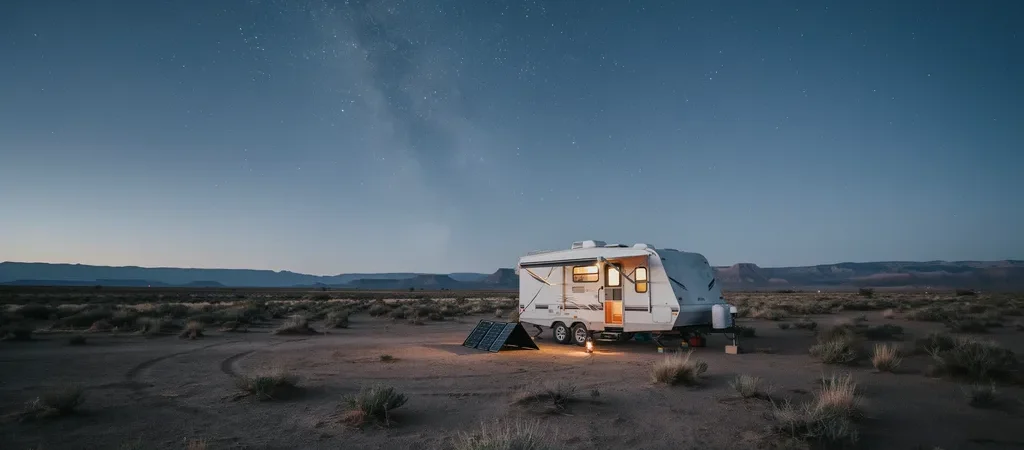
Once you have paid $80 a night for a gravel rectangle between two other rigs, the appeal of boondocking clicks: millions of acres of public land where camping costs nothing and your nearest neighbor is a juniper tree. No hookups, no reservations — just you, the rig, and whatever self-sufficiency you brought along.
Off-grid RVing is a skill set, not a secret handshake. Here is how to find legal spots, keep the lights on and the water flowing, and leave every site better than you found it.
Where Free Camping Is Actually Legal
The two big categories are BLM land (dominant across the West — think Arizona, Utah, Nevada) and national forest dispersed camping (nationwide). Both typically allow stays up to 14 days in one spot, free, on established sites along designated roads. Add Harvest Hosts / Boondockers Welcome style stays at wineries and farms, plus the one-night parking-lot standby (always ask the manager) for travel days.
Rules vary by district: some areas require free permits, some close seasonally for fire or mud. A five-minute check of the local ranger district page saves a 20-mile dirt-road backtrack.
Finding a Spot Your Rig Can Actually Reach
- Scout with Campendium, iOverlander, or FreeRoam — recent reviews tell you road condition, cell bars, and max rig size that fits
- Check satellite view for turnarounds before driving in; never take a big rig down an unscouted two-track
- Arrive with daylight, walk the last stretch on foot if in doubt, and take the first workable site rather than gambling on a better one at dusk
- Use existing bare-ground sites (fire rings are the tell) instead of flattening new vegetation
Power: The Solar + Generator Equation
Your house batteries run lights, water pump, and fans for a day or two — the fridge, phone chargers, and coffee habit are what drain them. The classic setup pairs portable solar for silent daytime charging with a quiet inverter generator for cloudy days and the occasional microwave or AC hour. A portable power station is the beginner-friendly middle path: charge it while driving, run the essentials at camp, no installation required.
Whatever you run, know your numbers: a phone is trivial, a 12V fridge sips, an air conditioner gulps. Most boondockers live comfortably on 200–400 watts of solar plus a 2,000–3,000W generator for backup.
Water: Arrive Full, Leave Empty
Water is the real limiter. Arrive with a full fresh tank, then stretch it: navy showers (wet, valve off, soap, rinse), a dish basin instead of a running tap, paper plates on the last days. A typical couple can stretch 40–60 gallons across five to seven days once the habits click. Carry a collapsible jug or two for top-up runs into town, and know your nearest dump station before you need it (apps list those too).
The Unwritten Rules
- Pack out everything — gray water included where required; never dump black anywhere but a dump station
- Generator hours: roughly 8 a.m.–8 p.m., and never aimed at a neighbor
- Space out — if you can read their door sign, you are too close
- Campfires only in existing rings, only when fire restrictions allow, always dead out
- The 14-day limit is real and rangers do check plates
Your First Boondocking Trip, De-Risked
Make trip one a single night on an easy, well-reviewed BLM road within an hour of a town. Treat it as a systems test: how fast do batteries drop, how much water did dishes take, does the generator annoy you more than the silence rewards you. Every answer tunes the next trip, and by the third you will wonder why you ever paid for the gravel rectangle.
Recommended Gear

- 224cc engine generates up to 4800 surge watts and 4000 rated watts
- Produces clean power to prevent damage to sensitive electronics such as smartphones, tablets and laptops
- The WEN Watchdog CO Shutdown Sensor helps protect both you and your family by automatically turning off the generator if…

- [Power for All Essentials] – With a capacity of 768Wh, 1000W inverter and 2000W power lifting, this power station is the…
- [1.5 Hours AC Charging] – No bulky power adapter, a single cable is enough to charge it with a maximum of 950W; 0-80% in…
- [Up to 500W Solar] – Fully charge the AC70 solar generator in 1.9-2.4 hours with max. 500W clean, environmentally friend…
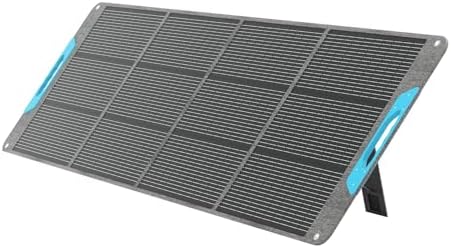
- [Industry-Leading Efficiency 25%] Upgraded with 16BB N-Type cell technology, Renogy solar panels for camping achieve 25%…
- [Lightweight & Magnetic Handle Design] Weighing only 13.89 lbs, renogy portable solar panel is the lightest in its class…
- [Versatile Off-Grid Power] Charge 3 devices simultaneously with 1 USB-C PD (45W max) and 2 USB-A ports (18W & 15W), perf…
Frequently Asked Questions
Is boondocking safe?
Statistically yes — remote public-land camping has very low crime, and most boondockers report feeling safer than in city campgrounds. Standard practice: trust your gut about a spot, keep valuables out of sight, know your exact location for emergencies (apps show coordinates), and have enough fuel to leave without refueling.
How long can my RV run off-grid?
Most rigs handle two to three days on batteries and fresh water without any upgrades, and five to seven days once you add solar or a generator and disciplined water habits. The hard limits are usually fresh water and gray tank space rather than power.
Can I boondock in a rented RV?
Usually yes, but check the rental agreement — some prohibit dirt roads or require you to stay in developed campgrounds. If allowed, confirm the rig’s battery and tank sizes with the owner so you can plan a realistic (usually shorter) off-grid stay.
Written by Jake Miller · Camping & Gear
Jake grew up pitching tents before he could drive and has spent 15+ years camping, car-camping, and gear-testing his way across the country. If it can be cooked over a fire or packed into a trunk, he has an opinion on it.