Heads up: this post contains affiliate links. If you buy through one, we may earn a small commission at no extra cost to you. As an Amazon Associate, we earn from qualifying purchases.
⚡ Quick Answer: For your first RV trip, book a full-hookup site at a developed campground within two hours of home, arrive with at least three hours of daylight left, and bring three non-negotiables: a surge protector, a water pressure regulator, and leveling blocks. Keep the first trip short and close so small mistakes stay small.
Your first RV trip is equal parts excitement and information overload. Between hookups, tanks, awnings, and campground etiquette, it can feel like everyone else got a manual you never received. The good news: RV camping runs on a handful of simple routines, and once you have done them twice, they become muscle memory.
This guide walks you through your first trip from booking to breakdown, with the beginner mistakes we see most often and the inexpensive gear that prevents the costly ones.
Pick the Right First Campground
Resist the urge to make your first trip an epic one. Choose a developed campground one to two hours from home with full hookups (electric, water, and sewer at your site) and pull-through sites if you can get one, so you do not have to back in on day one. State parks and well-reviewed private campgrounds are ideal; many have staff who cheerfully help newcomers.
Staying close to home means a forgotten item or a small problem is an inconvenience, not a crisis. Save the national park bucket list for trip three or four, once your setup routine is smooth.
The Three Items That Protect Your Rig
Campground power pedestals are notorious for wiring faults and voltage swings, and campground water pressure can spike far beyond what RV plumbing tolerates. Before anything else, put these three items in your RV basement:
- Surge protector / EMS unit — plugs in between the pedestal and your power cord and blocks bad power before it fries your electronics. Match it to your rig (30-amp or 50-amp).
- Water pressure regulator — a small brass fitting that caps pressure at a safe 40–50 PSI. It costs less than dinner and prevents burst lines.
- Leveling blocks — most sites are not perfectly level, and your fridge, tanks, and sleep all suffer when the rig leans. Stackable blocks fix it in minutes.
A Simple Arrival Routine
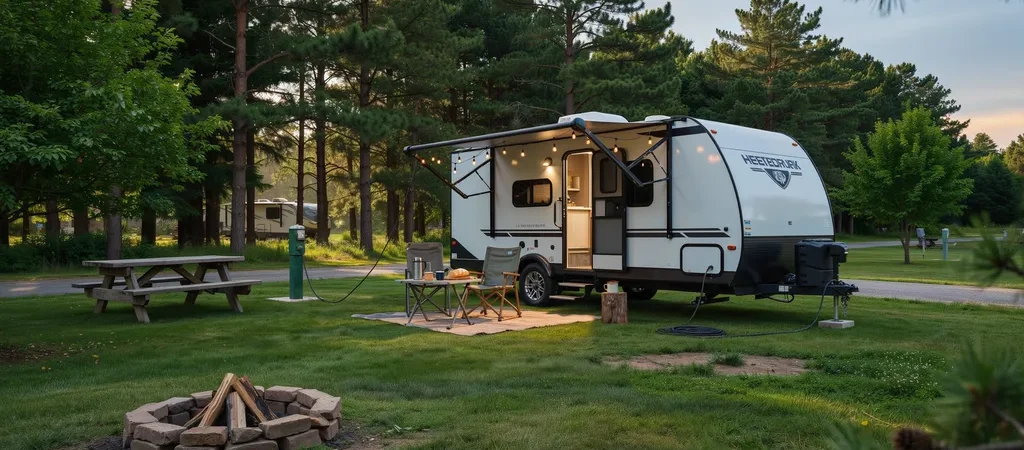
Arrive with daylight to spare and follow the same order every time. First, walk the site before pulling in: check for low branches, utility placement, and the flattest spot. Second, position the rig, level side-to-side with blocks, then chock the wheels firmly before anyone steps inside. Third, stabilize (tongue jack or leveling jacks), and only then connect utilities: surge protector into the pedestal with the breaker off, then power cord, then breaker on; regulator on the spigot, then the fresh water hose; sewer hose last, and leave the black tank valve closed until it is at least two-thirds full.
That whole sequence takes 20 minutes once practiced. Doing it in the same order every time is what keeps you from towing away with the antenna up or a hose still connected — the classic first-year mistakes.
Tanks, Explained in One Paragraph
Your RV has three tanks: fresh (clean water), gray (sink and shower water), and black (toilet). Keep the black valve closed at camp so solids stay suspended in liquid; dump it when two-thirds full, then dump gray afterward so the outflow rinses your sewer hose. Use RV-safe toilet paper and a tank treatment to keep odors down and sensors honest.
What to Skip on Trip One
You do not need a generator, solar panels, towing upgrades, or a full outdoor kitchen for a weekend on full hookups. Campgrounds provide the infrastructure; your job is learning the rhythms. Spend money on the protection items above and a good night of sleep, and let the rest of the wish list wait until real trips tell you what you actually miss.
Before You Leave: The 10-Minute Walkaround
Departure is where beginners get burned. Ten minutes, same order, every time: antenna and vents down, awning stowed and locked, steps up, tanks dumped and hoses stowed, power disconnected, jacks up, chocks pulled last, and one slow lap around the rig looking high and low. A laminated checklist taped inside a cabinet door beats memory every single trip.
Recommended Gear
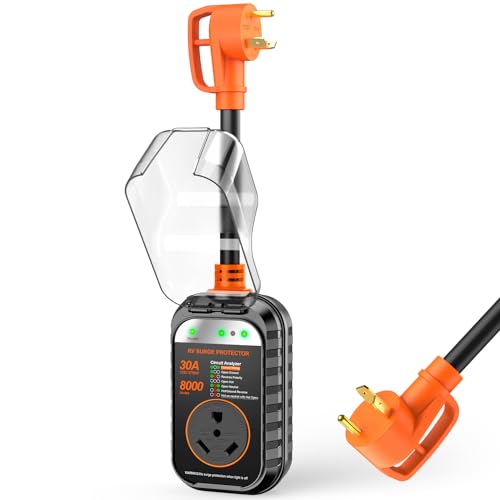
- Portable RV Surge Protectors: GEARGO RV Surge Protectors are designed to identifies faulty power and offers 8000 Joules …
- Circuit Analyzer: This allows you to test the quality of your power before connecting your RV, by verifying if the power…
- Safety Protection: FCC tested. V-1 flame-retardant materials and IP68 waterproof design make it extra safe to use. This …

- Protects RV/Marine Plumbing: Keep your RV/marine plumbing safe with this brass Camco water pressure regulator. Safeguard…
- Automatic Pipe Burst Protection: Ensure your pipes are safe using the built-in PSI Guard, preset at 40-50 PSI for automa…
- Safe for Drinking Water: Camco’s pressure regulator for RV water hoses is drinking water safe. It’s a must-have camper t…

- Modular designed interlocking leveling blocks configure to fit most leveling functions, and can withstand weights of up …
- A MUST HAVE for stability, leveling your appliances, having proper water drainage, and for overall comfort including get…
- The ORIGINAL RV LEVELING BLOCKS – Manufactured since 1992 and ALWAYS in the USA.
Frequently Asked Questions
Do I need a special license to drive an RV?
In nearly all US states, a standard driver’s license covers RVs and travel trailers under 26,000 pounds, which includes almost everything rented or owned by first-timers. A few states have extra rules for very large rigs, so check your state if you are driving a 40-foot Class A.
Should my first RV trip be in a rental?
Renting first is a smart, low-cost way to learn what layout and size actually fit your family before committing tens of thousands of dollars. Treat the rental weekend as a test drive: practice hookups, towing or driving, and note every annoyance for your buying shortlist.
How far in advance should I book a campground?
Popular state parks and full-hookup campgrounds in peak season often book one to six months out, and holiday weekends fill the day reservations open. For a first trip, aim for a shoulder-season weekday or book several weeks ahead for more site choice.
Planning your first routes? Don’t miss our guide to the 6 legendary RV road trip routes in America.
Written by Jake Miller · Camping & Gear
Jake grew up pitching tents before he could drive and has spent 15+ years camping, car-camping, and gear-testing his way across the country. If it can be cooked over a fire or packed into a trunk, he has an opinion on it.