
Heads up: this post contains affiliate links. If you buy through one, we may earn a small commission at no extra cost to you. As an Amazon Associate, we earn from qualifying purchases.
⚡ Quick Answer: To read a river: fish hold where current delivers food but doesn’t make them work — seams (fast water meeting slow), behind and in front of boulders, the head and tail of pools, undercut banks, and eddies. Learn to spot those six lies and you can walk up to any river in the country and know where to cast first.
Two anglers walk the same river. One casts everywhere and catches a fish or two; the other casts six specific spots and limits out. The difference isn’t the lure — it’s that rivers post signs about where fish live, written in current. Here’s how to read them.
The One Rule Behind Everything
River fish balance a budget: calories in (food the current delivers) versus calories out (energy spent holding position). Every good lie solves the equation the same way — slow water to rest in, right next to fast water carrying food. Once you see rivers as energy budgets, the spots practically glow.
The Six Lies to Learn
- Seams: the visible line where fast current meets slow. Fish sit on the slow side, darting into the conveyor belt to eat. The #1 spot on any river.
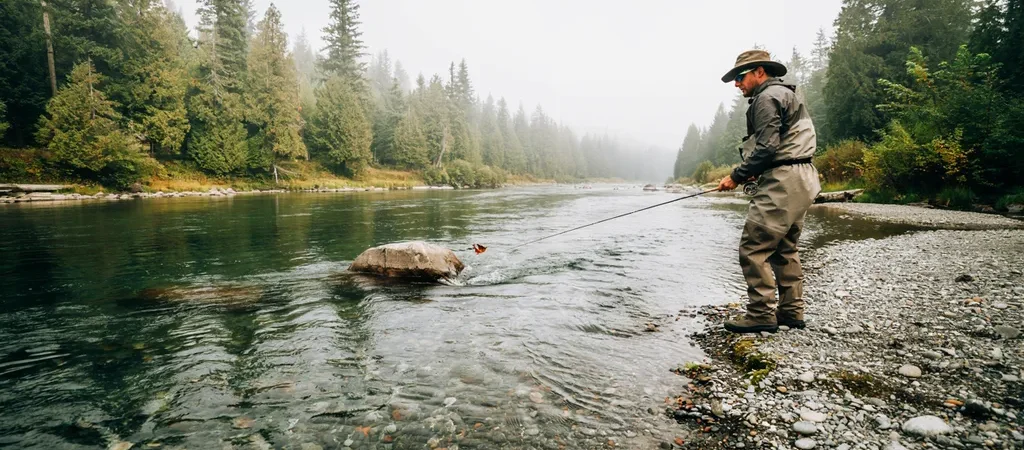
- Boulders: a cushion of slack water forms BEHIND (obvious) and IN FRONT (surprisingly good) of every big rock. Fish the front pocket everyone skips.
- Pool heads: where a riffle dumps into deep water — oxygen and food funnel in; the most competitive feeding real estate at dawn and dusk.
- Pool tails: the smooth shallowing exit — evening risers and spooky fish; approach low and slow.
- Undercut banks: deep outside bends with grass overhead hold the biggest fish in the river. Cast tight — inches matter.
- Eddies: the recirculating swirls behind points and logjams collect foam and food (“the foam is home”).
Reading Depth and Speed
- Surface texture is a depth gauge: choppy riffle = shallow and fast; smooth glassy glide = deeper and slower; standing waves = deep AND fast.
- Color reads depth too: lighter bottom-tinted water is shallow; the green-to-dark transition line is a fish highway.
- Polarized glasses aren’t optional — they delete surface glare and reveal boulders, drop-offs, and fish. The cheapest skill multiplier in river fishing.
Fishing the Water in Order
Work upstream where possible (fish face into current and see less behind them), and fish NEAR water before FAR — casting across the close seam to reach the far one puts every nearby fish down. Cover each lie with a few good drifts, then move; river fish commit fast when the presentation is right.
Seasonal Shifts
- High/cold water: fish hug the banks and the softest edges — the middle is a treadmill.
- Summer low water: oxygen rules — riffles, pool heads, and shade.
- After rain: rising, coloring water pushes fish tight to banks and turns on big fish briefly; falling clear water spreads them back out.
Match the water-reading to your quarry: trout in the seams, catfish in the deep bends, smallmouth behind the boulders. And for rivers worth a pilgrimage, start with our best fly fishing rivers.
Recommended Gear


- Multi-Pack Combination: Discover unbeatable value with KALIYADI 4-pack sport sunglasses, offering style, protection, and…
- Premium Materials: Crafted with premium materials for the active soul, KALIYADI mens sport sunglasses feature sturdy fra…
- Superior Advanced UV Protection: Venture into the great outdoors with confidence, knowing your eyes are shielded by sung…

Frequently Asked Questions
How do you read a river to find fish?
Look for places where current delivers food while fish rest: seams between fast and slow water, eddies behind rocks, undercut banks, and the head and tail of pools. Fish face upstream, so present your bait ahead of them.
Where do fish hold in fast water?
Behind anything that breaks the current — boulders, logs, bridge pilings — and along the softer edges of the main flow. The bottom itself is slower than the surface, so deep runs hold fish even when the top looks like a torrent.
What is a seam in fishing?
A seam is the visible line where fast current meets slow water. Food drifts down the fast side while fish hold on the calm side, darting out to eat. Casting so your bait drifts along that line is one of river fishing’s highest-percentage plays.

Written by Tom Rivera · Fishing & Hunting
Tom has spent four decades outdoors — on lakes, rivers, and treestands — and still fishes most weekends. These days his favorite catch is watching his grandkids reel in their first bluegill.