Heads up: this post contains affiliate links. If you buy through one, we may earn a small commission at no extra cost to you. As an Amazon Associate, we earn from qualifying purchases.
⚡ Quick Answer: You need a satellite messenger if you regularly go somewhere with no cell coverage, travel alone, or go far enough that walking out with an injury would not be possible. If your trips are on popular trails inside cell range and you always hike with other people, a charged phone plus a written trip plan covers most of the same risk for free.
Every gear guide has a financial incentive to tell you that you need the thing. So here is the version without that: most people who buy a satellite messenger did not strictly need one, and a meaningful minority of people who should own one do not. The question is worth answering honestly, because the answer changes how you pack for every trip afterward.
Four questions that settle it
Work through these in order. If you answer yes to two or more, buy one.
- Do you lose cell coverage on your trips? Check a coverage map for the areas you actually go, not the state you live in. Valleys and canyons drop signal even close to town.
- Do you ever go alone? A partner is the original safety device. Without one, nobody can go for help on your behalf.
- Could you walk out with a badly sprained ankle? Two miles on a flat trail, probably. Eight miles with a thousand feet of climbing, no.
- Would anyone notice you were late? If the honest answer is “not for a day or two,” you are relying on luck.
Notice that none of those questions are about how rugged or experienced you are. Experienced hikers get hurt at roughly the same rate; they just make better decisions afterward. The messenger is insurance against the part you cannot skill your way out of.
What you get for the money
A dedicated messenger buys three things. An SOS button that routes to a 24-hour coordination center. Two-way texting so you can say “sprained ankle, moving slowly, do not send a helicopter” instead of triggering a full response. And tracking, so someone at home can watch a dot on a map and know the trip is progressing.
That third one is underrated. Most of the value in practice is not the emergency, it is the ability to tell someone the truth about a delay so they do not call search and rescue when you are simply slow. If you want the model-by-model comparison, start with inReach vs ZOLEO vs SPOT and then the fuller best satellite messengers roundup.
The free version of the same protection
If you decide against buying one, do not simply skip the problem. Build the low-tech version deliberately.
- Write your route, trailhead, vehicle description, and turnaround time, and send it to one specific person. Not a group chat, one person.
- Agree on a check-in time and what they should do if you miss it by two hours.
- Enable satellite SOS on your phone if it supports it, and know the gesture to trigger it.
- Carry a whistle, a headlamp, and enough insulation to sit still overnight without becoming hypothermic.
- Download offline maps before you leave the driveway.
The gear side of that last cluster overlaps heavily with cold-weather layering. If you have never had to sit still in the cold on purpose, our base layer guide explains why the wrong shirt makes an unplanned night much worse.
Power is the failure mode nobody plans for
Phones die. So do messengers, faster than the box claims, especially with tracking on. Whatever you carry, carry a way to charge it, and check the bank is actually charged before you leave. This is the single most common gap between people who own safety gear and people whose safety gear works.
For multi-day trips this becomes a real calculation rather than a guess. We walk through it in how to keep your phone charged while backpacking.
When the answer is clearly yes
Buy one without further deliberation if any of these describe you: you solo hike or solo paddle, you hunt in remote country, you take kids into areas without coverage, you have a medical condition that could become urgent, or you regularly travel forest roads where a breakdown means walking. In each case the cost of the device is small compared to the specific thing it protects against.
And if you are heading into country where wildlife is a live concern rather than a theoretical one, pair the messenger with the region-specific preparation in wildlife safety by region and bear spray and deterrents.
If you buy a personal locator beacon rather than a subscription messenger, register it. Unlike a messenger subscription, PLB registration with NOAA is free and legally required — “it’s the law and it may save your life!” An unregistered beacon still sends a distress signal, but rescuers begin with no idea who you are or who to contact, which NOAA warns “may delay a SAR response.”
Recommended Gear
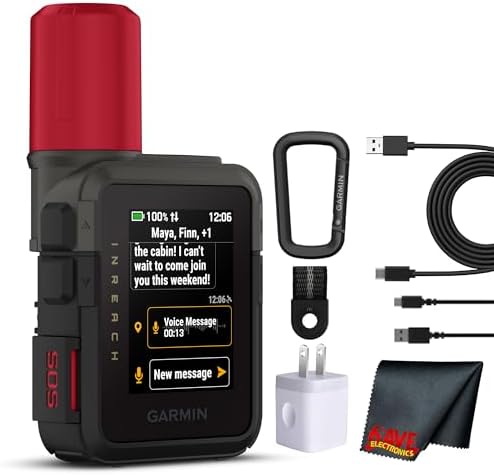
- Bundle Includes: Garmin inReach Mini 3 Plus compact SOS Satellite Communicator + Microfiber Cleaning Cloth + Generic Bra…
- GLOBAL MESSAGING AND MEDIA SHARING: Stay connected outside cell coverage using the Iridium satellite network and exchang…
- INTERACTIVE SOS AND REAL-TIME COORDINATION: Trigger an interactive SOS alert to Garmin Response, a 24/7 staffed emergenc…

- ResQLink View Personal Locator Beacon
- ResQFlare Electronic Distress Flare
- C-Strobe H2O Rescue Light

- No Subscription Required Enjoy peace of mind with no ongoing fees, knowing you’re always ready for rescue with reliable,…
- 406 MHz Distress and Homing Dignals Providing powerful alerts to rescuers, ensuring your location is quickly identified …
- LED Strobe and Infrared Strobe Ensures maximum visibility in low-light and nighttime conditions, making it easier for re…

- Global Two-Way Messaging: Allows communication with friends and family via text messaging, even in areas without cellula…
- Pairing with Garmin Messenger App: Connects with a compatible smartphone to send messages via satellite or cellular netw…
- Group Messaging and Threaded Conversations: Unlike many satellite communicators, the inReach Messenger supports group me…
Frequently Asked Questions
Does my phone work as a satellite messenger now?
Newer iPhones and some Android phones offer satellite SOS and limited satellite texting. It is a real safety improvement and worth enabling. It is not equivalent to a dedicated messenger, because it depends on your phone surviving the trip, having battery, and having a clear view of the sky, and coverage varies by country.
Is a whistle and a map good enough?
For short, popular, in-coverage trails with a partner, often yes. A whistle carries much further than a shout and weighs nothing. What it cannot do is reach anyone when there is nobody within earshot, which is exactly the scenario a messenger is for.
What is the cheapest way to be findable?
Tell a specific person your exact route and your turnaround time, in writing. It costs nothing and it is the single highest-value safety habit there is. A messenger tells searchers where you are; a trip plan tells them when to start.
Should I rent one instead of buying?
Rentals exist and make sense for a single big trip. Run the numbers: a week-long rental plus shipping often approaches a couple of months of a suspended-plan subscription on hardware you own. If you expect to take more than two remote trips a year, buying wins.
Do I need one for car camping?
Usually not, if you can drive out. The exception is remote dispersed camping or forest roads where a breakdown leaves you stranded with no signal. In that case the messenger is protecting you from a vehicle problem more than a wilderness one.
Written by Jake Miller · Camping & Gear
Jake grew up pitching tents before he could drive and has spent 15+ years camping, car-camping, and gear-testing his way across the country. If it can be cooked over a fire or packed into a trunk, he has an opinion on it.