
Heads up: this post contains affiliate links. If you buy through them, WildMorrow may earn a small commission at no extra cost to you. As an Amazon Associate, we earn from qualifying purchases.
⚡ Quick Answer: How to read a topographic map and use a compass, explained simply: what contour lines tell you, taking and following a bearing, orienting the map to the land, and handling declination.
Your phone is a brilliant map right up until the battery dies, the signal vanishes, or it takes a swim in a creek, which is precisely when you need a map most. Knowing how to read a topographic map and use a compass is the outdoor skill that never runs out of batteries. It sounds intimidating; it isn’t. In twenty minutes you’ll understand the language of the land. Here’s the plain-English version.
Reading a topo map: it’s all about the squiggly lines
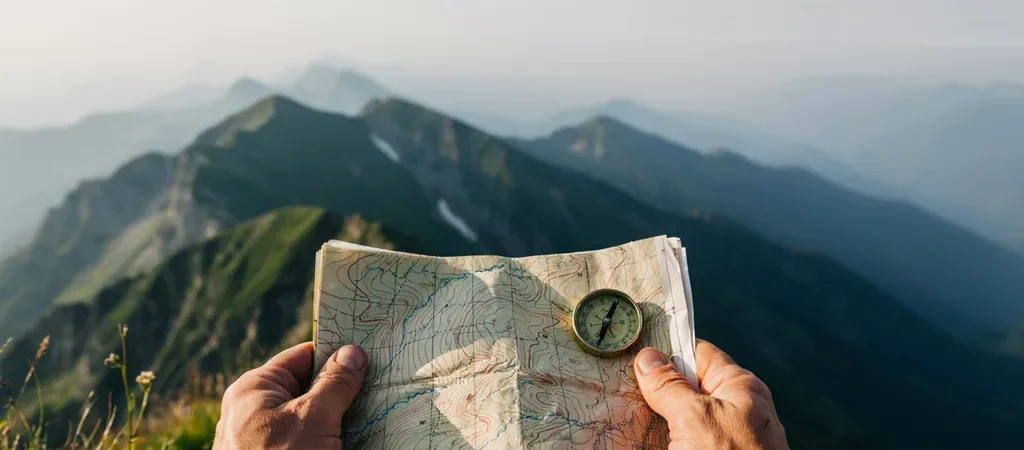
Those wavy brown lines (contour lines) are the whole trick. Each line connects points of equal elevation, so they map the shape of the land in 2D. The rules: lines close together mean steep terrain; lines far apart mean gentle ground. Concentric circles are a hilltop or peak. Lines forming a “V” that points uphill mark a valley or stream (water runs through the V); a “V” pointing downhill marks a ridge. Read a few and the flat paper turns 3D in your mind.
The compass, demystified
A baseplate compass has three parts that matter: the magnetic needle (red end points to magnetic north, always), the rotating bezel with degree markings, and the direction-of-travel arrow. To follow a bearing: point the travel arrow where you want to go, rotate the bezel until the needle sits in its outlined “shed” (box), then walk keeping the needle boxed. That’s navigation in one sentence.

- RELIABLE – Entry-level compass for your basic orienteering and mapping that can travel anywhere.
- ADVANCED NAVIGATION – Resists magnetic interference better than any competitor, and will not lose its polarity.
- GLOBAL NEEDLE – With the TruArc Global Needle system that is accurate in both northern and southern hemispheres, TruArc …

- The entry level compass Starter 1-2-3 is a great alternative when you just want to get going.
- It’s a compass appreciated by scouts, schools and leisure outdoor navigators.
- This compass combines simplicity with comfort and will become a reliable companion in all navigation situations.
Putting them together: orient the map
The single most useful skill: set your map so it matches the world. Lay the compass on the map, rotate the whole map until the map’s north lines up with the compass needle, and suddenly the mountain on paper points at the real mountain. Now you can spot where you are by matching terrain features (that lake, that ridge) to the map. Nine times out of ten, an oriented map is all the navigation you need.
The one gotcha: declination
Magnetic north and true (map) north aren’t the same, and the difference (declination) varies by location, from a few degrees to over fifteen. For casual hiking on marked trails it rarely matters; for serious backcountry navigation, adjust for it (many compasses let you set it once) or your bearings will drift you off course over distance. Your map’s margin lists the local declination.
Practice in your neighborhood
Walk a few bearings in a park, orient a map on a familiar trail, and it clicks fast. Carry map and compass as backup on every trip (they weigh almost nothing), and fold the skill into the essentials in our day hike checklist and outdoor safety guide. A GPS is great; knowing you’ll never truly be lost is better.
Frequently Asked Questions
How do you read contour lines on a topo map?
Each line connects points of equal elevation. Lines close together mean steep terrain; far apart means gentle. Circles mark summits, V-shapes pointing uphill mark valleys and drainages, and V-shapes pointing downhill mark ridges.
What is the contour interval on a map?
It is the elevation difference between adjacent lines — printed in the map legend, commonly 40 feet on USGS 7.5-minute maps. Count lines between you and a point, multiply by the interval, and you know the climb ahead.
Are paper maps still worth carrying?
Yes. Phones break, freeze, and die; a paper topo in a zip bag weighs nothing and never runs out of battery. Use the phone app as primary if you like, but the paper map plus a compass is the backup that keeps working.

Written by Sarah Brooks · Hiking & National Parks
Sarah fell in love with the outdoors on a childhood trip to the Smokies and has logged thousands of trail miles across 30+ national parks since. She is happiest above treeline with a map in hand.