Heads up: this post contains affiliate links. If you buy through them, WildMorrow may earn a small commission at no extra cost to you. As an Amazon Associate, we earn from qualifying purchases.
⚡ Quick Answer: How to choose a camp stove: the honest pros and cons of canister, two-burner, liquid-fuel, and wood-burning stoves, and exactly which type fits backpacking, car camping, winter, or ultralight use.
A camp stove is the difference between a hot dinner and a sad granola bar, but the options (canister, liquid fuel, wood-burning, two-burner) leave beginners paralyzed at the store. The good news: the right stove is obvious once you know how you’ll use it. Here’s how to choose a camp stove, with the honest pros and cons of each type.
Canister stoves (the easy, popular choice)
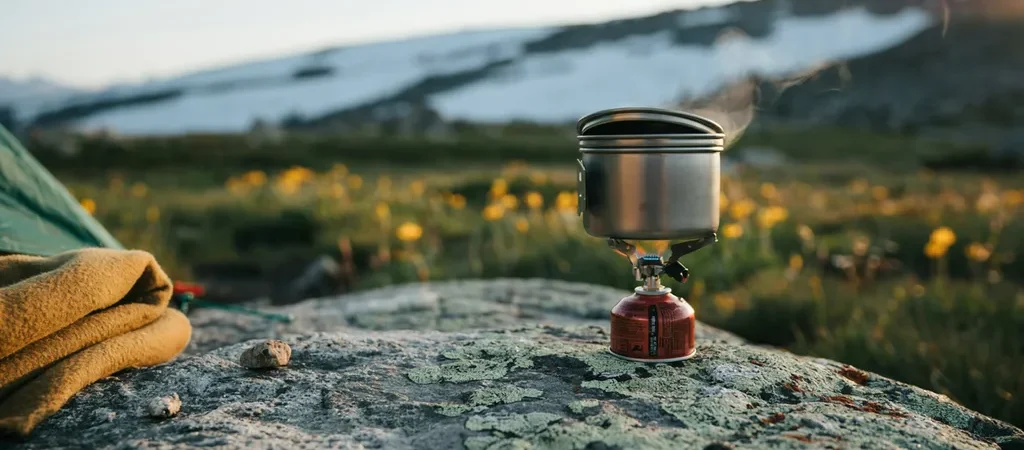
These screw onto a threaded canister of pre-pressurized isobutane and light with a push or a match. They’re the go-to for backpackers and most campers: tiny, light, fast to boil, and dead simple. The trade-offs: canisters cost more per use, are harder to recycle, and lose performance in serious cold. For 90 percent of hikers and weekend campers, a canister stove is the answer.

- Ultralight (2.6 oz) and compact (2x2x3 in) folding canister stove for minimalist adventures, backpacking, hiking, trekki…
- Boils one liter of water in just 3.5 minutes and flame easily adjusts from a simmer to a rolling boil for gourmet cookin…
- Fueled by high-performance isobutane-propane fuel canister (not included); self-sealing threaded canister fuel is availa…

- All-season stove fuel canister for backpacking and camp cooking
- Isobutane and propane blend performs well in cold temperatures
- High efficiency delivers fast boil times and steady output
Two-burner stoves (the car-camping king)
If you drive to your site, a classic two-burner propane stove is hard to beat: cook a full breakfast on one burner and coffee on the other, with the power and stability of a home stovetop. Heavy and bulky, so strictly for car camping, but the comfort is unmatched for family meals. (See our camping gear guide for our two-burner pick.)
Liquid-fuel stoves (the expedition workhorse)
These burn white gas (and often other fuels) from a refillable bottle, and they shine where canisters fail: extreme cold, high altitude, and international travel where canisters are hard to find. They’re pricier, require priming and occasional maintenance, and are overkill for casual use, but for mountaineers and world travelers, nothing beats them.
Wood-burning stoves (fuel is free, and everywhere)
A packable wood stove burns twigs, pinecones, and bark, so you never carry or run out of fuel, and there’s real joy in cooking on a tiny fire. The catches: they’re smoky, sooty on your pots, useless in a fire ban or wet conditions, and slower than gas. A fun ultralight option and a great backup, but not your only stove.

- COMPACT AND PORTABLE: Elevate your backpacking experience with this 6.25” x 5” x 5” wood stove designed to collapse down…
- QUICK AND EASY SETUP: Just unpack the components and insert the tabs into their corresponding slots, transforming them i…
- ULTRALIGHT DURABILITY: Crafted from Grade-1 titanium, this wood stove combines exceptional strength with an ultralight d…
So which should you buy?
Backpacking or minimalist camping: a canister stove, plus tablets or a plan B. Car camping with family: a two-burner propane stove. Winter, altitude, or global travel: a liquid-fuel stove. Ultralight fun or emergency backup: a wood stove. Whatever you choose, practice lighting and cooking on it at home first, and never run any stove inside a tent (carbon monoxide is deadly). Then put it to work with our campfire cooking and Dutch oven guides.
Frequently Asked Questions
What kind of camp stove should a beginner buy?
A two-burner propane stove for car camping — stable, powerful, and simple — or a canister screw-top stove for backpacking. Both light instantly and simmer well enough for real cooking. Specialty liquid-fuel and wood stoves come later, if ever.
How long does a propane canister last on a camp stove?
A standard 1-pound propane cylinder runs a two-burner stove roughly 1 to 1.5 hours at full blast — call it a weekend of normal meals on one or two cylinders. Cold weather and wind cut that noticeably; a windscreen stretches it.
Can you use a camp stove inside a tent?
No. Stoves in tents cause carbon monoxide poisoning and tent fires every year. Cook outside with ventilation, and if weather forces shelter, cook under an open-sided tarp — never inside closed fabric.
Written by Jake Miller · Camping & Gear
Jake grew up pitching tents before he could drive and has spent 15+ years camping, car-camping, and gear-testing his way across the country. If it can be cooked over a fire or packed into a trunk, he has an opinion on it.