

Heads up: this post contains affiliate links. If you buy through one, we may earn a small commission at no extra cost to you. As an Amazon Associate, we earn from qualifying purchases.
⚡ Quick Answer: What to do if you get lost hiking — the STOP method rescuers teach, why staying put beats wandering, how to signal searchers, and the habits that prevent it entirely.
Getting lost rarely happens all at once. It creeps in: the trail looks a little less trail-like, the landmarks stop matching, and somewhere in the last half hour you crossed from “hiking” into “wandering.” What you do in the next ten minutes determines whether this becomes a story or a search-and-rescue mission. The answer is an acronym rescuers teach: STOP.
The Moment You Feel Lost: STOP
- S — Stop. Literally stop walking. Every step in the wrong direction makes you harder to find. Sit down, drink some water, eat something. Panic is the real enemy, and blood sugar fights it.
- T — Think. When were you last certain of your location? What direction have you traveled since? What do you remember passing?
- O — Observe. Check your map, phone GPS, or compass. Look for the trail, footprints, blazes, sounds of roads or water. Can you see landmarks to match against the map?
- P — Plan. Only act on a plan you’re confident in. If backtracking to your last known point is certain, do it. If nothing is certain, stay put.
Why Staying Put Usually Wins
If you told someone your plan (you did, right?), searchers will start from your route — and a stationary person near a trail is found quickly. A moving person expands the search area by miles every hour. Statistically, lost hikers who stay put are found faster and in better shape than those who push on. Wandering downhill “toward civilization” is how people end up in drainages that cliff out, miles from any search grid.
If You Must Wait: Get Found Faster
- Make yourself visible: bright gear out, in a clearing if one is near.
- Three of anything means SOS: three whistle blasts, three shouts — repeat every few minutes. A whistle carries far beyond your voice and never gets hoarse.
- Stay warm and dry before you get cold and wet — put on layers early, get off bare ground, build a simple shelter and (if safe) a fire. See our emergency shelter guide.
- Conserve phone battery: airplane mode, then try texts (they send on weaker signal than calls) from high points. Text 911 works in many counties.
- Don’t split the group. Ever.
Never Get Truly Lost Again
- Tell someone where you’re going and when you’ll be back — the single highest-value habit in the outdoors.
- Download offline maps before the trailhead, and carry a paper map and compass you know how to use: our map and compass guide takes an afternoon to learn.
- Look back regularly — trails look different in reverse, and that’s the view you’ll need.
- Note the time at every junction; “we turned left about 40 minutes ago” is navigation gold.
- For remote country, a satellite messenger turns “lost” into “delayed.”
Every experienced hiker has had a “misplaced” hour — the difference is they caught it early, stopped, and worked the problem. Round out the skillset with our day-hike checklist and safety tips.
Recommended Gear

- Package List: we will provide you with 12 pcs emergency whistles and 12 pcs hiking survival compasses, sufficient in qua…
- Loud 120 dB Survival Whistle: each safety whistle delivers a powerful 120 decibel sound that can be heard from up to a m…
- Easy To Carry & Quick Access: the compact design whistle measures 2.01 x 0.83 x 0.67 inches/ 5.1 x 2.1 x 1.7 cm, and the…

- Package Includes: you will receive 50 emergency whistles, along with an equal number of lanyards and keychains for easy …
- Practical Material: our survival whistles are made of aluminum alloy, making them sturdy and wear-resistant, suitable fo…
- Multiple Styles: our whistles with keychain come in five bright colors: red, green, purple, gold, and blue; The colors a…
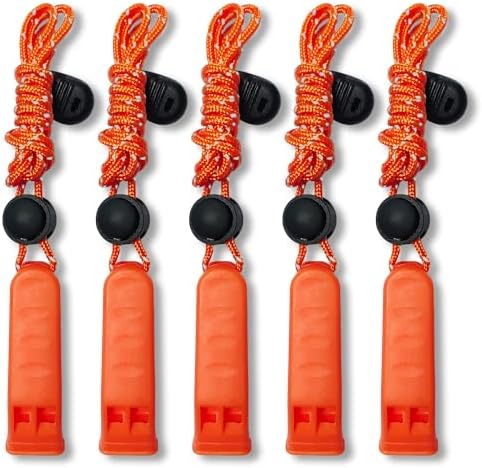
- Very Loud: A whistle with a two-tone chamber increases the sound power to be heard from a mile away and acts as a signal…
- One-Piece Molding: The whistle is made of a one-time molding, which means that there are no parts, no breakage, and it i…
- Adjustable Lanyard: Whistle with reflective cord for high visibility even in the dark, adjustable rope so you can easily…
Frequently Asked Questions
What should you do first when lost hiking?
STOP: Stop, Think, Observe, Plan. Sit down, breathe, drink water, and resist the urge to keep moving — panic walking turns slightly-lost into deeply-lost. Try to backtrack mentally to your last known point before moving at all.
Should you stay put or try to find your way when lost?
If someone knows your trip plan, staying put wins: searchers find stationary subjects faster, and rescue usually comes within 24 hours. Move only with a concrete reason — no one expects you, injury, or hazard — and then follow drainages downhill deliberately, marking your path.
How do you help rescuers find you?
Get visible and audible: open ground if possible, three whistle blasts repeated, bright gear displayed, and a smoky fire if conditions safely allow. Answer any shout or whistle even if exhausted — searchers stop calling where no one answers.

Written by Sarah Brooks · Hiking & National Parks
Sarah fell in love with the outdoors on a childhood trip to the Smokies and has logged thousands of trail miles across 30+ national parks since. She is happiest above treeline with a map in hand.