
Heads up: this post contains affiliate links. If you buy through one, we may earn a small commission at no extra cost to you. As an Amazon Associate, we earn from qualifying purchases.
⚡ Quick Answer: The best microspikes for icy winter trails — microspikes vs. crampons vs. snowshoes, what to look for, Kahtoola picks, and when to put them on.
Ice is what turns winter’s easiest trail into its most dangerous. Microspikes fix that for under $75: slip-on traction that bites into packed snow and ice, letting you keep hiking straight through the season most people sit out. Here’s how they compare to crampons and snowshoes, and which to buy.
Microspikes vs. Crampons vs. Snowshoes
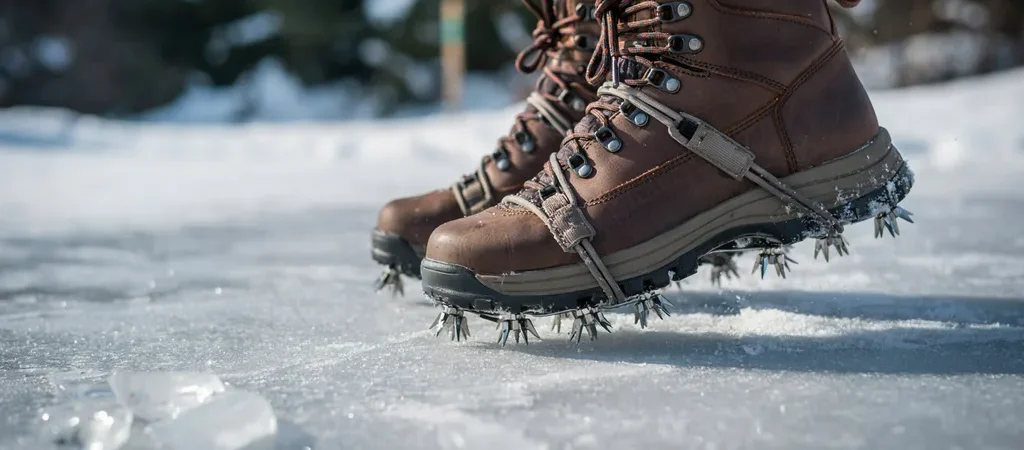
- Microspikes: short (¼–½”) spikes on chains stretched over any boot. For icy, packed-snow trails — the winter day-hiker’s default.
- Crampons: long aggressive points for steep ice and mountaineering. Overkill (and awkward) on regular trails.
- Snowshoes: for deep, unpacked snow — flotation, not traction. Different problem entirely; see our snowshoeing guide.
- Rule of thumb: icy/packed trail → microspikes; deep powder → snowshoes; steep frozen couloir → crampons and training.
What to Look For
- Stainless spikes, welded chains: the quality difference between brands lives here — cheap spikes bend and chains pop.
- Secure elastomer harness: should stretch on tight and stay put through miles of walking.
- Sizing: match to your winter boot size (with thick socks), not your sneaker size.
- Carry bag: spikes in a pack pocket without one will remind you why it was included.
Top Traction Devices
Kahtoola MICROspikes are the category-defining original — the pair you see on every winter trailhead — with solid budget alternatives behind them:

- BEST FOR: Winter hiking, backpacking, ice-trekking, ice fishing and trail-running. The MICROspikes are designed for all-…
- SPIKE DESIGN: 12 heat-treated stainless-steel corrosion resistant spikes per foot. 8 spikes at the forefoot, and 4 spike…
- ELASTOMER HARNESS & REINFORCED EYELETS: Using a patented eyelet design, tough TPU inserts reinforce key stress points, a…

- ULTRALIGHT TRACTION REDEFINED: Over 43% lighter than the original, MICROspikes Ghost trades steel chains for durable the…
- HYBRID ELASTOMER HARNESS WITH REINFORCED EYELETS: An innovative design combines durable TPR at the toe and flexible ther…
- ADDITIONAL PREMIUM FEATURES: Articulating rivets create a rock-solid connection while allowing spikes to move independen…

- VERSATILE: Designed for hiking boots with rigid or soft soles and insulated winter boots. Suitable for ice, snow, mud, a…
- DURABLE: Hardwearing and equipped to handle diverse winter terrain and a wide variety of winter weather conditions. Idea…
- TRACTION: Large carbon steel plate system with 11 carbon steel 17mm spikes. A hinged front plate system allows for flexi…
When to Put Them On
- At the first consistent ice — not after the first fall. Slips injure wrists and tailbones before people bother stopping.
- Take them off for long bare-rock stretches; steel on stone is slippery and dulls the points.
- Carry them October through May in the mountains — two pounds of insurance that lives in the pack.
- Poles with snow baskets complete the winter stability picture — see our trekking pole guide.
Winter Trail Notes
Traction solves the falling problem, not the cold problem: winter hiking still means layers, early turnarounds, and telling someone your plan. Our cold-weather guide and snowshoeing trails list cover the rest of the season’s toolkit.
Frequently Asked Questions
What are microspikes and when do you need them?
Microspikes are traction devices with small metal spikes on a rubber harness that stretch over your boots to grip packed snow and ice. Use them on icy or hard-packed winter trails where slipping is a risk. They are lighter and less aggressive than crampons, which are for steep mountaineering.
What is the difference between microspikes and crampons?
Microspikes have short spikes for walking on rolling icy trails and are easy to put on over hiking boots. Crampons have long, aggressive points for steep snow and ice climbing and require compatible stiff boots. For most winter hiking, microspikes are the right, more convenient choice.
How do you choose the right size microspikes?
Microspikes are sized to your shoe or boot size, so check the manufacturer sizing chart and match it to the footwear you will wear them over, allowing for thicker winter boots. A snug fit keeps them from shifting or coming off. When between sizes, account for the bulk of your winter boots.

Written by Sarah Brooks · Hiking & National Parks
Sarah fell in love with the outdoors on a childhood trip to the Smokies and has logged thousands of trail miles across 30+ national parks since. She is happiest above treeline with a map in hand.