
Heads up: this post contains affiliate links. If you buy through one, we may earn a small commission at no extra cost to you. As an Amazon Associate, we earn from qualifying purchases.
⚡ Quick Answer: Wildfire safety outdoors: check fire danger and active-incident maps before every trip in fire season, obey burn bans absolutely, and leave EARLY if you see smoke or get an alert — roads out of fire country close fast. Caught near fire: move downhill and upwind toward cleared ground (roads, rock, water), never uphill or into a canyon, and breathe through a wetted cloth or N95.
Fire season is now a planning factor across much of the country, and campers and hikers are often the first people near a new start. Wildfire safety splits into three skills: not starting one, not being near one, and getting out early when things change. Here’s all three, plainly.
Don’t Start One (The Camper’s Half)
- Burn bans are absolute: when posted, no campfires — full stop. Stoves with shut-off valves are usually legal; check locally (our stove guide covers ban-friendly options).
- Dead out means COLD: drown, stir, drown again, hand-test. A fire that’s “mostly out” relit by wind is how many fires start (full drill in the campfire guide).
- No fires on windy days, ever — embers travel astonishing distances.
- Vehicles: no parking or idling over dry grass (hot exhaust starts fires), and trailer chains off the pavement.
Before and During Fire-Season Trips
- Check the fire danger rating, active-fire maps (InciWeb, Watch Duty-style apps), and forest alerts the day you leave — and again en route.
- Sign up for county emergency alerts where you’re headed; download offline maps of ALL exit roads, not just the one you came in on.
- Smoke forecast matters too: hazardous air can end a trip a hundred miles from flames. Pack N95s in the glove box in fire season.
- Camp with egress in mind: one-way-in canyon campsites are gorgeous and terrible in a fire.
If Fire Threatens
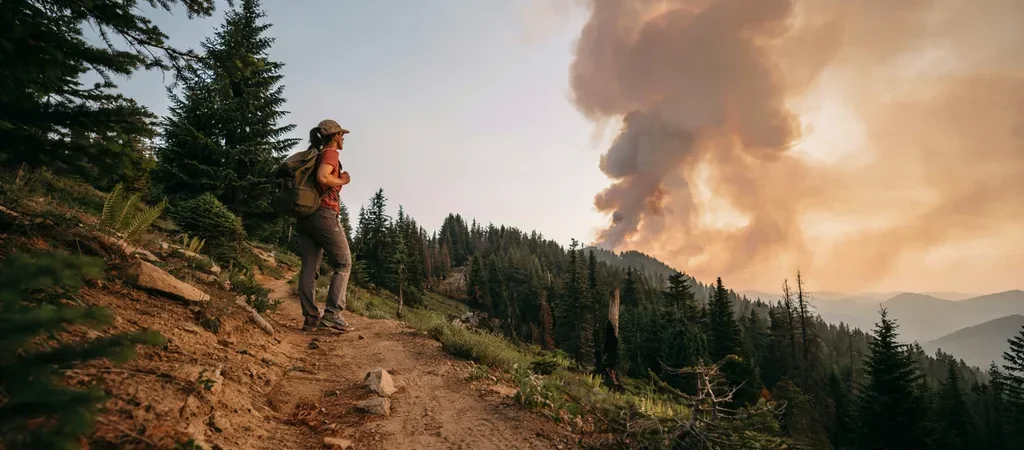
- Leave at the first sign — visible smoke column, ash fall, official alert, or that gut feeling. Early departures drive out; late ones get trapped by road closures.
- Fire moves FAST uphill and through canyons (heat rises, terrain funnels wind) — evacuate downhill, upwind, toward big cleared areas: roads, rock fields, large water, green irrigated land.
- On foot and cut off: get to the biggest fuel-free area available (river bar, lake, rock slabs, burned-over ground), breathe low through wet cloth, protect airways above all.
- In a vehicle in smoke: lights on, windows up, vents closed, drive deliberately — and never drive blind into smoke across a road.
After: Smoke and Burn Scars
Hazardous smoke days call for postponed trips (heavy exertion in smoke does real harm — the sensitive-groups warnings mean hikers too). And give recent burn scars a wide berth for a season or two: hazard trees drop without wind, and burned slopes turn storms into debris flows (see flash flood safety).
Fire country is still glorious country — pine forests, canyons, the whole West. Respect the season, keep the exits open, and let the forecast make the call. Related: lightning safety, signaling for help, and emergency radios for alerts off-grid.
Recommended Gear

- NIOSH-APPROVED N95 for at least 95 percent filtration efficiency against certain non-oil-based particles and aerosols
- USE FOR: Sanding, drywall cutting, sweeping, sawing, woodworking, fiberglass insulating, yard work, grinding and dusting
- 3M ADVANCED ELECTROSTATIC MEDIA enhances the capture of airborne particles and allows for easy breathing


- NIOSH APPROVED: For at least 95% filtration efficiency against certain non-oil based particles like dust
- COOL COMFORT: 3M Cool Flow Valve, incorporating proprietary technology, helps reduce heat and humidity build-up inside t…
- FEWER PRESSURE POINTS: M-noseclip adjusts easily for fewer pressure points, a custom and secure seal, and greater comfor…
Frequently Asked Questions
What should you do if a wildfire starts near your campsite?
Leave immediately — do not wait to pack everything. Head away from the fire, downhill and upwind if possible, toward roads, water, or already-burned ground. Report it by calling 911 as soon as you have signal.
How can campers prevent wildfires?
Check fire restrictions before every trip, keep fires small and inside rings, never leave them unattended, and drown-stir-drown until cold. In dry or windy conditions, skip the fire entirely — a stove makes dinner just as well.
How close is too close to camp near a wildfire?
If you can see flames, a growing smoke column, or falling ash, you are too close. Fires can move faster than a person runs, especially uphill and in wind. Check InciWeb and local alerts when planning trips in fire season.

Written by Sarah Brooks · Hiking & National Parks
Sarah fell in love with the outdoors on a childhood trip to the Smokies and has logged thousands of trail miles across 30+ national parks since. She is happiest above treeline with a map in hand.